
There was a time when sharing good news required effort. You called someone. You met them for dinner. You trapped a coworker near the copier and made them look at four poorly developed photographs from your trip to Cancun.
Now you can inform 900 people, including your high school lab partner, a former landlord, and three women you vaguely remember from a wedding—that your toddler successfully used the toilet.
This is called progress.
Social media was originally supposed to help us stay connected. Instead, it created millions of unpaid publicists representing the world’s least interesting celebrity: themselves.
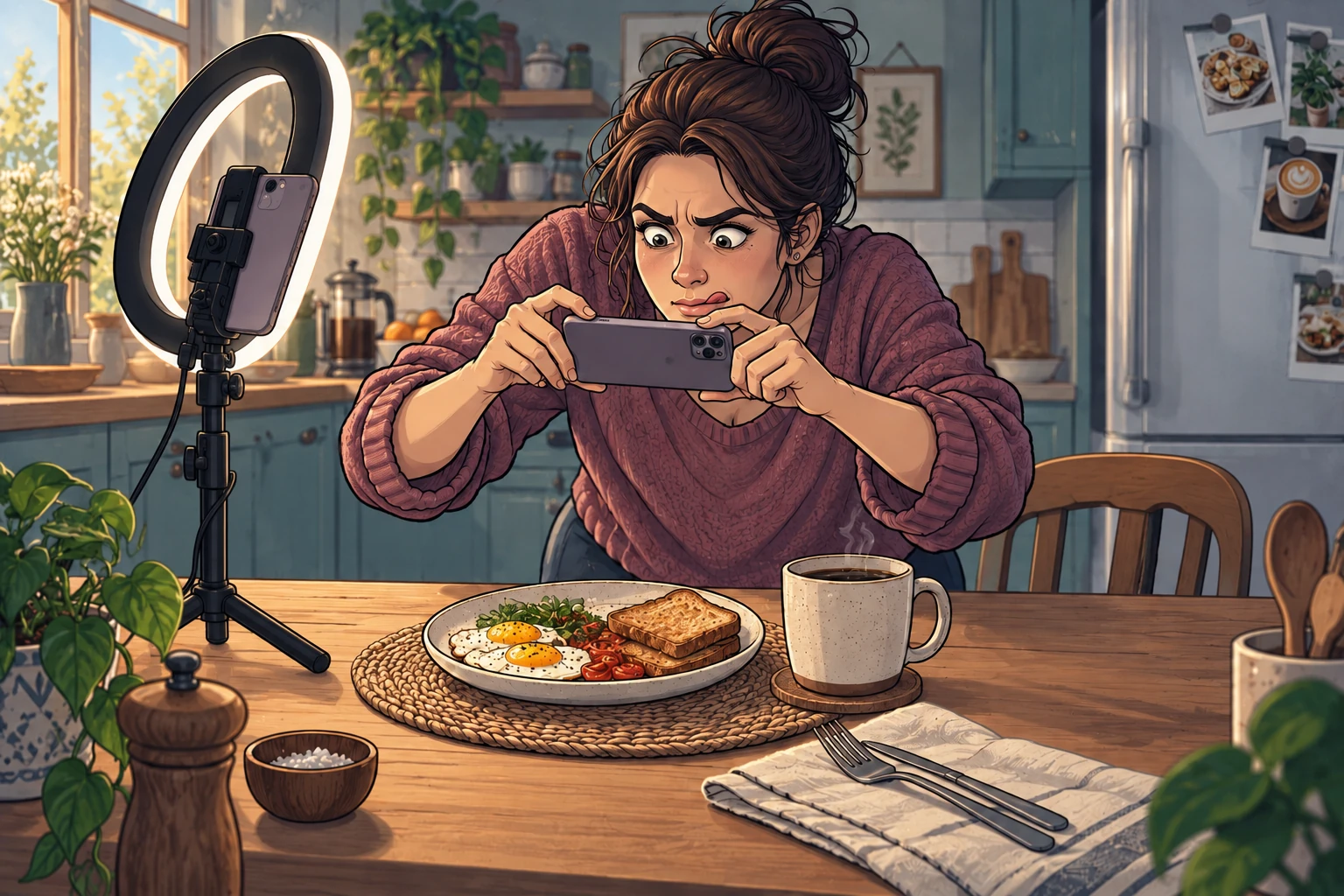
Every breakfast is a press release. Every workout is a documentary. Every disagreement becomes an ominous quote about “protecting my peace.” Every vacation requires photographic evidence that the vacation occurred, preferably featuring a pair of feet pointed toward an ocean that looks exactly like every other ocean on Instagram.
Nobody simply goes to Italy anymore. They launch a multimedia campaign about having gone to Italy.
The strangest part is how quickly ordinary life has been reorganized around its potential value as content. People no longer ask whether they enjoyed something. They ask whether they captured it. If a sunset occurs and nobody films it while slowly panning toward a cocktail, did the sun legally set?
Birthdays have become brand activations. Proposals require concealed photographers. Pregnancy announcements now have art direction. Even grief arrives with a carefully selected carousel and a caption that begins, “I wasn’t sure whether to share this.”
You were sure. That is why we are all looking at it.
“I wasn’t sure whether to share this” is social media’s version of someone walking onto a stage, tapping the microphone and claiming they hate attention.
Of course, the people documenting every second of their lives will insist they are doing it “for the memories.” Apparently, human memory stopped functioning around the time Instagram introduced Stories. Our grandparents somehow remembered entire marriages without filming themselves crying in the passenger seat while a sad song played underneath.
There is also the mysterious “social media break,” which must always be publicly announced. A person cannot simply stop posting. They must issue a farewell address, usually explaining that they need to “be present” and “focus on what really matters.”
They return nine days later with a photo dump.
The addiction isn’t really to sharing. It’s to being witnessed. The meal tastes better if strangers see it. The relationship feels more legitimate after an anniversary tribute. The morning run becomes meaningful once its distance, route, pace, heart rate and emotional significance have been distributed to people who were trying to look at basketball highlights.
We have created a culture in which private satisfaction barely registers. Happiness must now pass through an audience before it feels real.
And look, I understand the hypocrisy here. Anyone criticizing oversharing online is probably doing so online. We are all swimming in the same contaminated pool. Some of us are merely pretending that standing in the shallow end makes us less covered in urine.
But there should be limits.
Your spouse does not need a 700-word birthday caption written as if they died storming Normandy. Your child did not consent to having his potty-training setbacks distributed to former coworkers. Your followers do not require hourly updates from the emergency room. And if you are posting cryptic accusations like “Some people will never understand loyalty,” either name the defendant or take the case back to private court.
Not every thought needs witnesses. Not every emotion needs engagement. Not every minor life event needs to be fed into the enormous digital machine so it can spit out 43 likes, two fire emojis and a comment from your aunt asking whether you received the birthday card she mailed.
You are allowed to eat a meal without photographing it. You may attend a concert without recording the worst video ever made. You can love your partner without publishing an annual performance review. You can feel sad without arranging your face near a window and selecting the appropriate grain filter.
You can even experience a beautiful moment and allow it to disappear.
That used to be called living.
Now it probably needs a hashtag.