
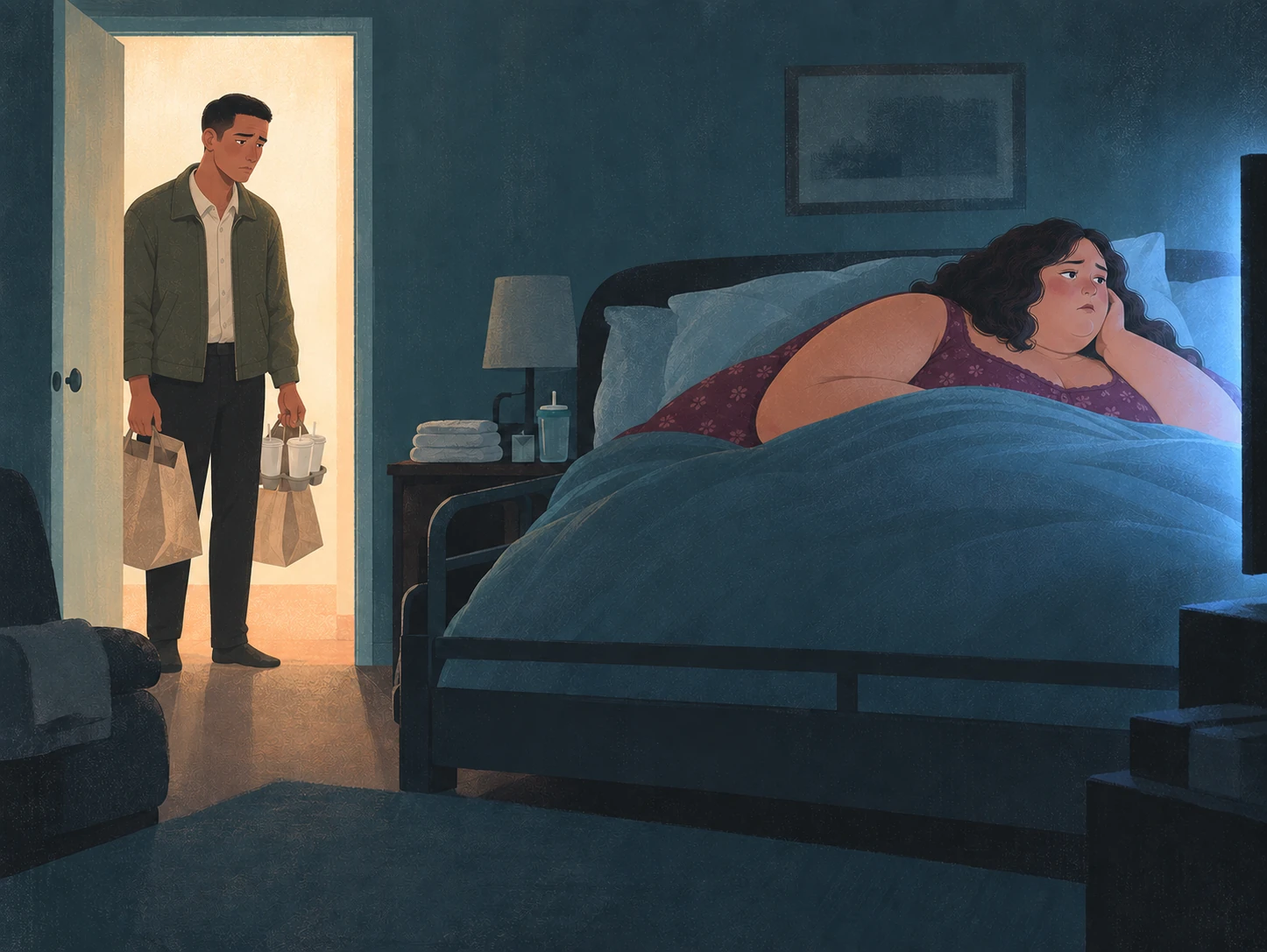
I was 24 when I was offered more money than I had ever made in my life to become the live-in caretaker for a woman who weighed more than 600 pounds.
A friend of mine knew her family and recommended me because I already had experience as a caretaker. He told them I could be trusted. The family was extremely wealthy, and they were willing to pay an incredible amount of money as long as I agreed to live in the house and be available whenever she needed me.
The accommodations were beautiful. My food and housing were completely covered. On paper, it sounded like an opportunity I would have been stupid to refuse.
What I did not fully understand was that I was agreeing to give up my life.
She needed someone beside her almost constantly. There were no regular hours and no real days off. She slept at strange times because she was practically bedbound, so my schedule depended on hers. If she was awake in the middle of the night and needed something, I had to be awake too.
I could not make plans. I could not go out whenever I wanted. I had almost no social life. I was making all this money, but I had no time or freedom to enjoy it.
The woman was in her late 30s. She had apparently been injured years earlier and became immobile while recovering. During that period, she gained a significant amount of weight. Even after she recovered from the injury, the weight gain continued.
By the time I met her, eating had become the center of her life.
I estimate that she consumed around 10,000 calories on some days. There were enormous fast-food orders from McDonald’s, Burger King, KFC and Taco Bell. When she asked me to cook, it was usually huge portions of pasta, chicken or some other food loaded with oil, carbohydrates and fat.
Between the takeout and the groceries, she could go through roughly $1,000 worth of food in two weeks. For most families, that would have been a serious expense. For her family, it was nothing.
My job was to give her whatever she asked for.
That included the food.
People have asked me why I did not simply refuse. The honest answer is that I was an employee. Her family told me to do whatever she wanted, and she did not want to change. I tried talking to her about eating healthier, but those conversations went nowhere. I made healthier meals for myself, but she wanted what she wanted.
I knew I was helping her continue the behavior that had put her in that bed. I also knew what I was being paid to do.
That is the part of the job I still have complicated feelings about. I was there to take care of her, but “taking care of her” often meant bringing her the very food that was taking away what little mobility she had left.
When I started, she could still make it to the shower with help. As she continued gaining weight, even that became impossible. Eventually, I had to bathe her in bed.
There is no polite way to describe the physical reality of caring for someone that size.
I washed between the folds of her body with sponges and used large amounts of baby powder to keep the areas dry. Sweat, oil and moisture collected deep inside those folds. Her diet and her size created a powerful body odor. She also passed gas constantly.
At first, the smell was overwhelming. After enough time, I became used to it. I did not suddenly find it pleasant. My mind simply stopped reacting to it as strongly. There are things the human brain learns to treat as normal when it has no other choice.
She could not use a normal toilet. She used a bedpan and sometimes pads. When she finished, I cleaned her. I wiped her after bowel movements. I helped her bathe, cleaned every part of her body and changed what needed to be changed.
At first, that level of intimacy was deeply uncomfortable for me. For her, it seemed completely ordinary.
She would talk to me while I cleaned her as casually as if we were sitting across from each other at lunch. She did not appear embarrassed. She did not apologize or try to avoid eye contact. She would keep talking about a television program or ask me a question about my life while I was wiping her.
Sometimes I felt that she enjoyed the bathing and physical care more than she should have. I never had a sexual relationship with her, and nothing sexual was part of my job. But there were moments when her reaction to being washed or touched made me uncomfortable.
Looking back, I also understand that this may have been the only human contact she received.
She had no friends who came to see her. In the year and a half I lived there, her family visited only twice. Her mother and an aunt were the only relatives I remember seeing. They barely spoke to her when they came. She never mentioned siblings, rarely discussed her family and never talked about her father.
She was surrounded by money and almost completely abandoned.
Before I arrived, another caretaker had visited about twice a week. Once I took over, I became her caretaker, cook, cleaner and nearly her entire social world.
Most of her days consisted of eating, sleeping and watching television. She would talk about whatever program was on, but what she really enjoyed was asking about my life. She wanted to hear about where I came from, what I thought and what I hoped to do. We had long conversations almost every day.
Sometimes I wanted to be alone, but she always found a way to keep me talking.
I used to wonder how she could stand the boredom. Now I think hearing about my life allowed her to experience a little of the world she no longer entered herself.
Despite everything, she was a nice person. That made the situation harder.
It would be easier to tell this story if she had been cruel or demanding all the time. Then I could say that I stayed only for the money and felt nothing when I left. But we had a decent relationship. I felt sorry for her. I saw the loneliness underneath the eating and the strange acceptance of her circumstances.
At the same time, I became frustrated with her.
She did not seem interested in changing. She never appeared tired of eating. Food made her happy in a way that little else did. She did not talk as though she was trying to regain her mobility or rebuild her life. Her world became smaller and smaller, and she behaved as if that were simply how life was going to be.
Her family did nothing to interrupt it.
They had enough money to hire doctors, therapists, dietitians, physical therapists and multiple professional caregivers. Instead, they paid one young man an enormous amount of money to live with her and keep her comfortable.
I cannot say what had happened inside that family before I arrived. She did not like talking about them, and I did not push her. But from what I witnessed, it felt as if they had decided she was a problem they could pay someone else to handle.
They did not have to watch her lose the ability to shower. They did not have to clean her body, empty her bedpan or bring her another giant order of fast food. They did not have to sit beside her while she ate herself further into immobility.
I did all of that for them.
For a long time, I told myself that it was not my place to interfere. I was not a doctor or a therapist. I was an employee following the instructions I had been given. She was an adult and could make her own decisions.
All of that was true.
It was also true that every meal I carried into her room helped maintain the situation. I may not have created the problem, but I became part of the system that allowed it to continue.
The money made that easier to accept.
Because I lived there and had almost no expenses, I was able to save and invest most of what I earned. I focused on the future. Whenever the job became disgusting, exhausting or emotionally draining, I reminded myself how much money I was accumulating.
Eventually, those savings allowed me to buy an apartment. I now work in finance. In that sense, the job changed my life for the better.
But after a year and a half, I could not continue.
She was still gaining weight, and her mobility was getting worse. Tasks that had been difficult at the beginning were becoming nearly impossible for one person to perform safely. I had made enough money, and I knew I needed to leave before the job swallowed any more of my life.
When I told her, she understood. We had built a real relationship, and leaving was emotional, but we parted on good terms.
Her family did not ask me to train a replacement. I do not know what arrangements they made after I left.
I do not even know whether she is still alive.
That is difficult to admit after spending almost every hour of every day with someone for a year and a half. For that period, I knew when she slept, what she ate, what she watched and what her body needed. I knew things about her that most people would never allow another person to see.
Then I left, and she disappeared from my life.
People sometimes ask whether I regret taking the job. I do not have a simple answer.
It was the hardest job I have ever had and, financially, the best. It gave me a start in life that I might never have gotten otherwise. It also showed me what happens when unlimited money is combined with addiction, isolation and a family that no longer wants to be involved.
People imagine that wealth solves every problem. In that house, money did the opposite. It allowed everyone to avoid the problem.
Her family used money to avoid caring for her themselves. She used their money to keep eating whatever she wanted. I accepted their money to carry out her requests, even when I knew those requests were making her condition worse.
Everyone got something they wanted.
Her family got distance. She got food and companionship. I got financial security.
And while all of us benefited in some way, she kept getting bigger, weaker and more trapped inside that room.
That is the part I cannot make sound better than it was.