
I had wanted to visit Egypt for years.
The pyramids, the Egyptian Museum, Islamic Cairo, the Nile—there are certain places you grow up seeing in books and documentaries so often that they almost stop feeling real. Egypt was one of those places for me. I knew Cairo wasn’t going to be Paris. I wasn’t expecting clean sidewalks, orderly traffic, or some sanitized tourist experience. If anything, the chaos was part of what I was looking forward to.
What I wasn’t prepared for was how exhausting it would be to simply exist there as a tourist.
It started almost immediately.
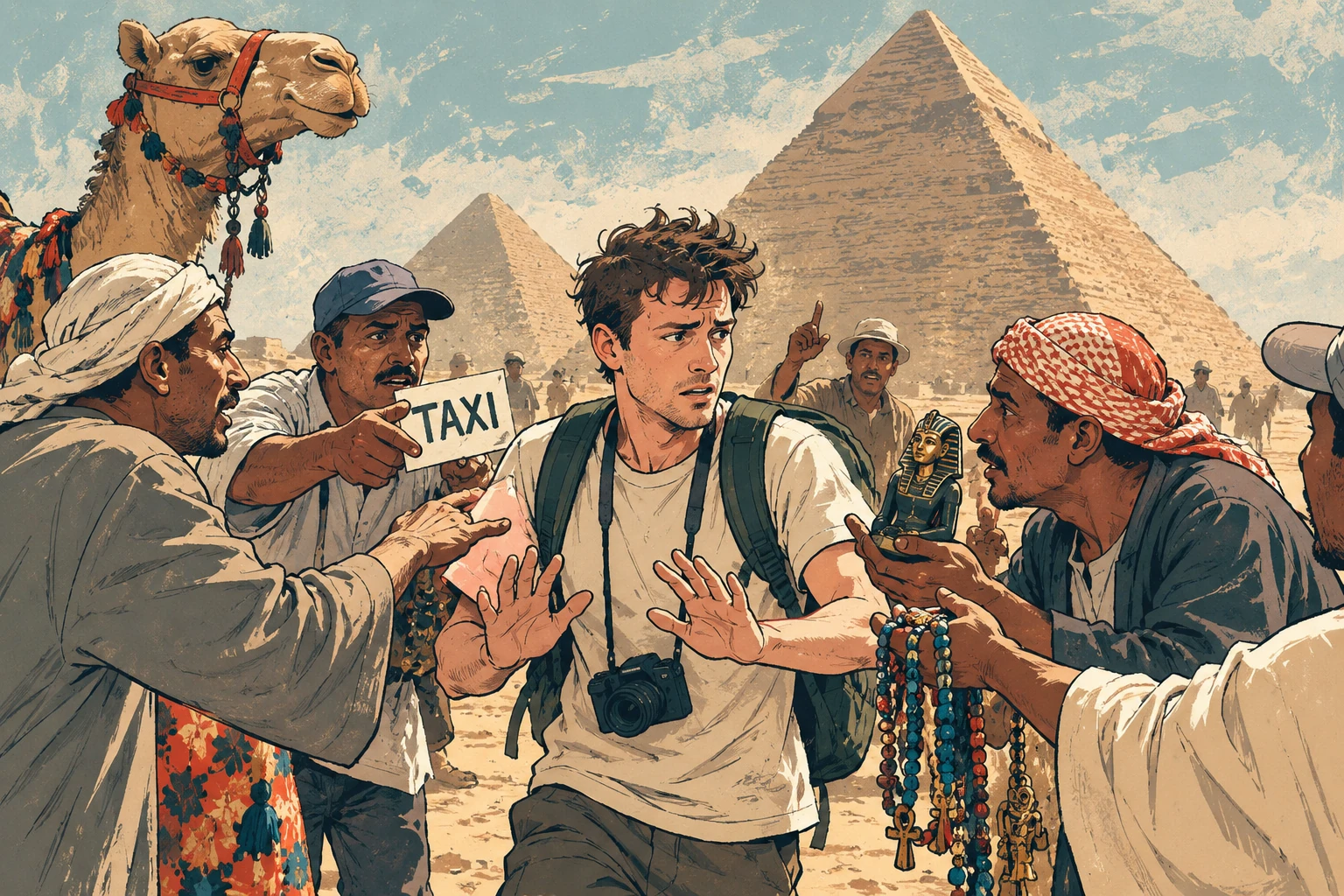
You quickly learn that walking around Cairo, and especially Giza, means constantly being approached. Taxi. Camel. Horse. Tour. Souvenir. Papyrus. Perfume. “Where are you from?” “My friend!” “Come look, no buying.” “Let me help you.”
At first I tried to be polite.
That lasted about a day.
The problem isn’t that somebody tries to sell you something. I’ve traveled enough to expect that. The problem is the relentlessness of it. You say no and they keep walking beside you. You say no again and they ask why. Someone offers to show you where an entrance is. Someone else offers to take your picture. Someone tells you the entrance you’re walking toward is closed. Someone puts something in your hand and tells you it’s a gift.
Eventually you realize that almost every interaction has the potential to end with somebody asking you for money.
And that changes you.
By the third day, I hated the person I was becoming. Someone would smile at me and my first thought wasn’t, “That’s friendly.” It was, “What does this guy want?”
That’s probably the worst thing Cairo did to me.
There were genuinely kind people there. I’m sure I ignored some of them. But after you’ve had enough experiences where friendliness turns into a sales pitch or an unsolicited favor turns into a demand for a tip, you stop giving strangers the benefit of the doubt.
Uber was supposed to make things easier.
Instead, even that became stressful.
I’d request a ride and occasionally get a driver who wanted me to cancel it and pay cash instead. Sometimes the price suddenly changed. Sometimes there was some explanation for why the amount in the app wasn’t enough. Other travelers I met had variations of the same story.
Eventually every ride became another negotiation I didn’t want to have.
That’s Cairo in a nutshell: everything feels like it has the potential to become a negotiation.
You buy water and wonder if that’s the real price. You order food and wonder what the bill is going to look like. You get into a car and wonder whether the driver is going to ask for something extra. Someone offers directions and you wonder whether you’re about to owe him money.
One meal finally broke me.
I went somewhere local because I specifically didn’t want to spend the entire trip eating inside hotels. I ordered what should have been a cheap meal. Then food I hadn’t ordered started appearing on the table. Bread, sides, little plates. I assumed some of it came with the meal.
When the bill arrived, suddenly everything had a price.
Then there was the tip.
Then another person became involved.
What should have been a completely ordinary lunch turned into an argument over several times what I thought I owed. At some point I stopped caring about being right. I paid more than I should have simply because I wanted to leave.
That’s another thing I wasn’t expecting: how often you eventually pay just to make an interaction end.
Giza was even worse.
Seeing the Great Pyramid for the first time is genuinely incredible. Photographs don’t convey the scale of it. You stand there looking at something built more than four thousand years ago and for a moment you understand why people spend thousands of dollars and fly across the world to see it.
Then someone asks if you want a camel.
No.
“Good price.”
No, thank you.
“Where you from?”
I’m okay.
“Come, come. Just picture.”
No.
“My friend!”
And suddenly you’re negotiating your escape from a conversation you never wanted to have.
You walk another hundred feet and start over with somebody else.
Camel ride. Horse ride. Guide. Photo. Souvenir. “Special entrance.” “Best view.” “I work here.” “Official guide.”
The pyramids are one of the greatest things human beings have ever built, and somehow I spent a significant portion of my time there trying not to make eye contact with people.
That felt almost tragic.
I wanted to stand there and absorb it. Instead, part of my brain was permanently occupied with defending my wallet.
Staying near the pyramids also turned out to be a mistake for me. I imagined waking up, looking out at Giza, and having this magical Egyptian experience.
The view was incredible.
The neighborhood wasn’t.
Once you’ve seen the pyramids, there isn’t the same kind of easy wandering you might imagine when booking the hotel. Getting into central Cairo can mean sitting in traffic, and Cairo traffic deserves its own category of insanity.
Lanes seem more like suggestions. Horns are a language. Cars squeeze into spaces that don’t appear to physically exist. Pedestrians walk into moving traffic because apparently that’s how you cross the street.
At one point I was riding in a car when we hit a motorcyclist.
Within seconds people surrounded us. Doors were being opened. Everyone was shouting. I had absolutely no idea what was happening or whether I was supposed to get out, stay inside, call someone, or disappear.
Eventually police arrived.
The whole time I remember thinking: I am on vacation.
That’s what became so absurd about the trip.
Nothing individually was necessarily enough to ruin Egypt. A taxi argument is a taxi argument. Getting overcharged happens everywhere. Aggressive vendors exist in dozens of countries. Traffic can be terrible in any major city.
It was the accumulation.
Every day seemed to require this low-level vigilance from the moment I left the hotel.
Check the price.
Confirm the price.
Confirm it again.
Don’t accept the gift.
Don’t hand over your phone.
Don’t follow the guy showing you the entrance.
Don’t believe the attraction is closed.
Don’t let someone carry your bag.
Don’t get into the wrong car.
Don’t cancel the Uber.
Don’t assume the food appearing on the table is complimentary.
Have small bills.
Don’t look confused.
Keep walking.
Say no.
Say no again.
Eventually traveling stopped feeling like traveling and started feeling like playing defense.
And Cairo itself is already exhausting before any of that happens.
It’s enormous. It’s loud. It’s dusty. Traffic is constant. Horns are constant. Crossing some streets feels like a trust exercise with God. There are moments when the city has this incredible energy, especially downtown, but there’s almost nowhere for your senses to rest.
After a few days, I started doing something I almost never do when traveling.
I stayed in my hotel.
I’d look up a restaurant or neighborhood I wanted to visit and then think about the Uber ride, the traffic, getting approached, negotiating prices, getting back afterward—and decide I didn’t want to deal with it.
That bothered me more than anything.
I had flown halfway around the world to experience Cairo and Cairo had somehow convinced me to sit in a hotel room.
The frustrating part is that Egypt’s historical sites really are extraordinary.
The pyramids are extraordinary.
Standing in front of the Sphinx is surreal.
Seeing objects you’ve known from history books sitting a few feet away from you is something I’ll remember forever.
There were also Egyptians who were incredibly warm and helpful and wanted absolutely nothing from me. That’s important to say because reducing a city of more than ten million people to its worst tourist interactions would obviously be ridiculous.
I also met travelers who loved Cairo. Some hired guides and drivers for almost everything and had completely different experiences. Others seemed naturally better at brushing off the chaos. They laughed at the haggling and treated it like part of the adventure.
I couldn’t.
Maybe that’s on me.
But I’ve traveled enough to know the difference between a place challenging me and a place wearing me down.
Cairo wore me down.
Toward the end, I realized I hadn’t relaxed outside my hotel in days. Every approaching stranger made me tense up slightly. Every price became something I questioned. Every supposedly helpful gesture made me suspicious.
That’s not how I want to travel.
I don’t regret seeing Egypt. I’m glad I stood beneath the pyramids. I’m glad I saw the Nile. I’m glad I got to experience a city completely unlike anywhere I’d been before.
But when people ask whether I’d go back, I don’t have to think about it.
No.
There are too many places in the world where I can spend my day being curious instead of guarded.
Egypt gave me some of the most incredible things I’ve ever seen.
Unfortunately, it also made seeing them feel like work.