
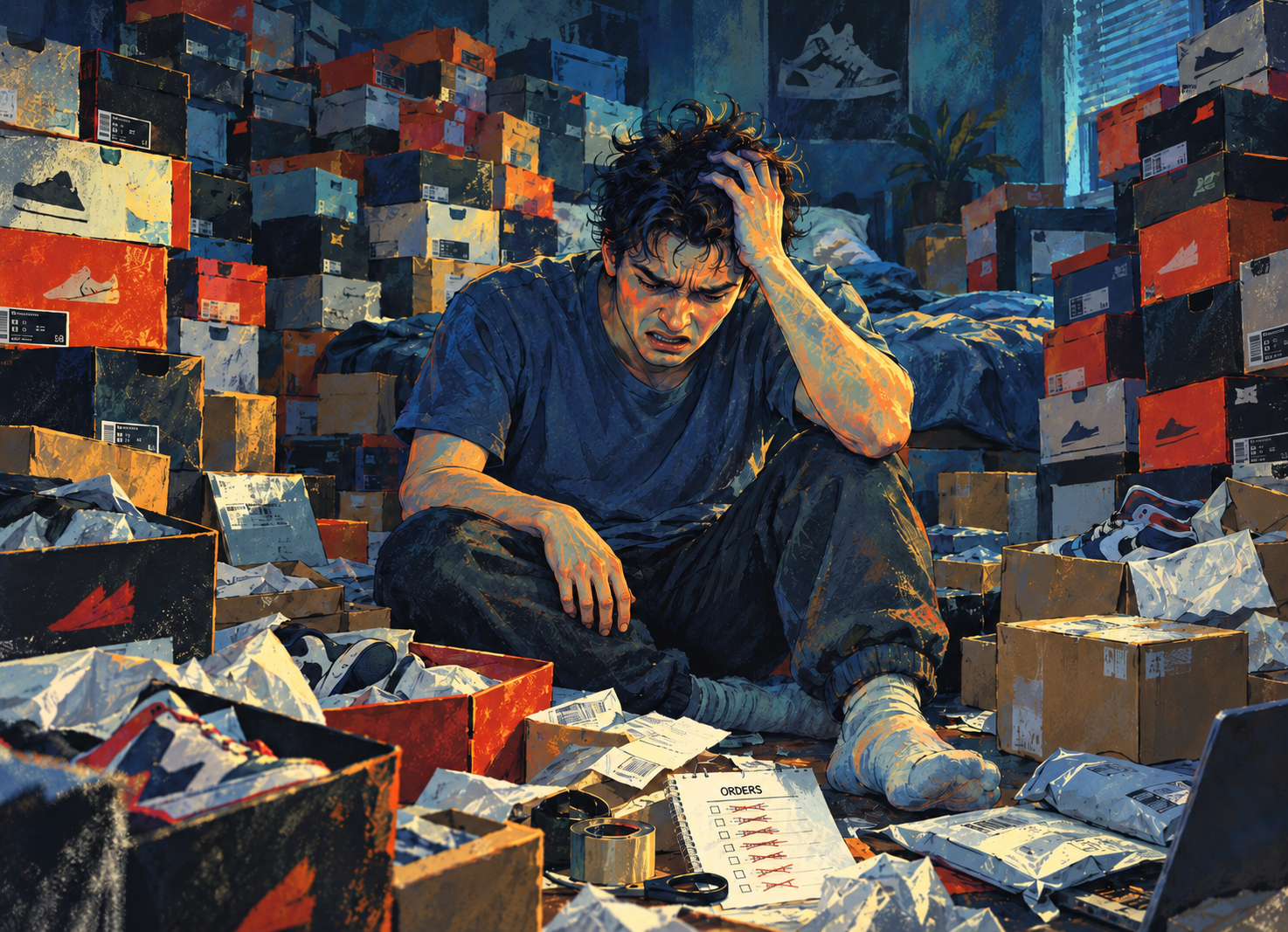
There are few pleasures in life more satisfying than watching an entire industry of self-important assholes discover that nobody actually needs them.
And right now, sneaker resellers are getting a long-overdue introduction to that reality.
For years, these guys operated under the belief that buying a $180 pair of Jordans and immediately listing them for $600 constituted entrepreneurship. They weren’t selling shoes. They were “building businesses.” They weren’t hoarding inventory in their childhood bedrooms. They were “managing assets.”
Every dipshit with a sneaker bot and a Shopify account suddenly thought he was Warren Buffett with a ring light.
And the worst part? For a while, it actually worked.
A generation of grown men convinced themselves that standing outside Foot Locker at 5 a.m. to buy shoes they had no intention of wearing was a legitimate career path. Instagram filled up with 23-year-old sneaker moguls posing in front of walls of cardboard boxes, offering motivational advice about grinding, chasing the bag, and escaping the nine-to-five.
Brother, you’re selling Nikes out of your mom’s garage. Calm the fuck down.
The entire operation depended on a beautifully stupid arrangement: sneaker companies manufactured scarcity, resellers exploited it, and ordinary people paid three times retail because some YouTuber told them a particular colorway was going to change their lives.
Want a pair of shoes? Too bad. A guy named Tyler bought seventeen pairs using automated software, and now he’d like you to pay him an additional $250 for the privilege of putting them on your feet.
And Tyler was insufferable about it.
He’d call you broke if you complained about the markup. He’d tell you to respect the hustle. He’d post pictures of his inventory with captions about financial freedom, as though humanity had been waiting thousands of years for someone brave enough to invent buying something and selling it for more.
But something wonderful happened.
People started losing interest.
The hype cooled. More releases became easier to buy. Shoes that once would’ve inspired fistfights in shopping malls began sitting on shelves. And the resale market started delivering the kind of financial education that no business school could ever provide.
According to one 2026 analysis of more than 3,500 sneaker releases, nearly 60 percent were selling below retail.
Below. Retail.
Imagine spending years calling yourself a sneaker investor only to discover your portfolio would’ve performed better if you’d just kept the money in your checking account.
Now the same guys who once demanded $500 for a pair of plastic-and-leather basketball shoes are desperately typing “PRICE DROP” into Instagram stories, hoping somebody will take their dead inventory off their hands.
The market has a name for these shoes. They’re called bricks.
Which is perfect, because that’s exactly what these geniuses have been stacking in their bedrooms for the past five years.
And listen, there’s nothing wrong with making money. There’s nothing inherently wrong with reselling something, either. But sneaker resellers managed to turn a perfectly ordinary commercial activity into an entire personality disorder.
They weren’t content to make a profit. They needed you to admire them for it.
They wanted to be seen as visionaries. Tastemakers. Financial masterminds. Men who had cracked the secret code of capitalism.
Except their revolutionary business model was essentially being the asshole who buys all the concert tickets before anyone else can get one.
They created absolutely nothing. They improved absolutely nothing. They took a product people wanted, made it harder to obtain, then charged everyone extra to solve the problem they’d helped create.
And somehow, we’re supposed to applaud the entrepreneurial spirit.
Now comes the best part: the rationalizations.
The sneaker market isn’t struggling. It’s “correcting.”
Their inventory isn’t worthless. It’s a “long-term hold.”
They’re not stuck with forty-seven pairs of unsold Dunks. They’re “diversifying their strategy.”
Of course, sneaker reselling hasn’t completely died. There will always be rare shoes, limited collaborations, and collectors willing to pay ridiculous sums for objects they intend to keep inside boxes until the sun explodes.
But the glorious era when every unemployed guy with a Discord server could pretend to be a Wall Street commodities trader appears to be taking a well-deserved beating.
And frankly, it’s beautiful.
Because somewhere out there is a guy who spent $12,000 stockpiling sneakers, convinced he’d turn them into $30,000. He watched YouTube videos about passive income. He told his girlfriend she didn’t understand investing. He probably described himself as a serial entrepreneur on LinkedIn.
And now he’s staring at a mountain of unsold shoes, wondering whether he can get his money back.
There’s a lesson here about speculation, artificial scarcity, and the dangers of confusing a temporary market inefficiency with personal genius.
But I prefer the simpler interpretation.
Sometimes the universe just hands an asshole a receipt.