


I would like to buy something and then be left alone.
Apparently, this is an unreasonable request in 2026.
There was a time when you could walk into a store, hand someone money, take a product home, and that was the end of your relationship with the company. You owned the thing. They had your money. Everybody moved on with their lives.
Now you buy something and the company spends the next six years trying to figure out how to charge you for it again.
You buy a security camera. Great. It records things. Except if you actually want to watch those recordings, that will be $9.99 a month.
You buy a printer. Wonderful. Except now the printer company would very much like you to enroll in a monthly ink subscription, because apparently purchasing ink cartridges when you need them is an outdated concept.
You buy a car. The heated seats are already installed. The wiring is there. The heating elements are sitting directly beneath your ass. But some genius in a corporate boardroom looked at that and thought, “What if we charged them every month to turn those on?”
BMW actually experimented with a heated-seat subscription before abandoning it. Think about the kind of mind that comes up with this. You manufacture the car. You install the equipment. You sell the car. And then you try to charge the customer rent on the equipment that’s already in the car they own.
It’s almost impressive.
And every subscription is conveniently priced to seem insignificant.
$4.99 here. $7.99 there. $12.99 for something you use twice a year. They’re all just small enough that you don’t feel compelled to cancel them, which is precisely the point.
Somewhere, an executive is looking at a spreadsheet showing that 400,000 people forgot to cancel a free trial, and he’s having the best day of his life.
The companies love to describe this as a better customer experience. They talk about convenience, flexibility, seamless access, and personalized solutions.
What they mean is recurring revenue.
And I understand why businesses love recurring revenue. If I owned a company and could convince customers to keep paying me indefinitely for something they already bought, I’d probably be pretty excited about it too.
But could we at least stop pretending this is being done for our benefit?
Software is probably the most irritating example. You used to buy a program and use it until your computer couldn’t run it anymore. Now you’re paying monthly for the privilege of opening a PDF, editing a photograph, or using software you’ve already learned how to operate.
Stop paying and the functionality disappears.
And that’s the part that really bothers me. We’re slowly being trained to accept that ownership is no longer the default. Everything is becoming temporary access, contingent on keeping your credit card on file.
Of course, subscriptions make sense for some things. Streaming services have ongoing licensing and infrastructure costs. Software that receives constant updates requires maintenance. Fine. Nobody is suggesting Netflix should operate like a toaster.
But when a physical product sitting inside your home needs a monthly payment to perform a basic function, perhaps we’ve lost the plot.
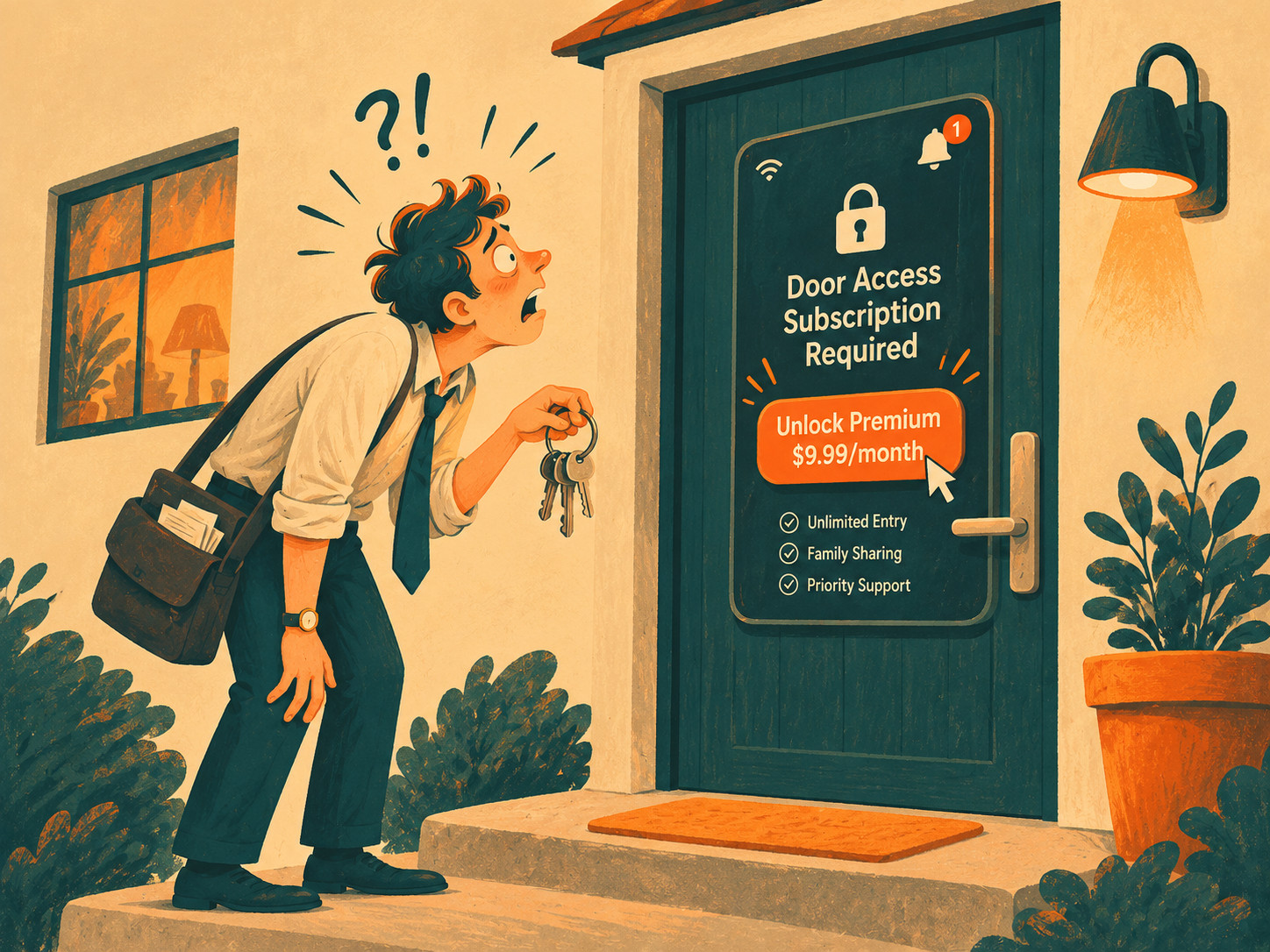
I don’t need a relationship with my doorbell. I don’t want my toothbrush manufacturer emailing me about exclusive member benefits. I don’t need a loyalty program for the privilege of using something I already paid for.
I just want to buy the damn thing.
And then, in a truly revolutionary development, own it.
Was this worth your time?
What missed? (optional)