







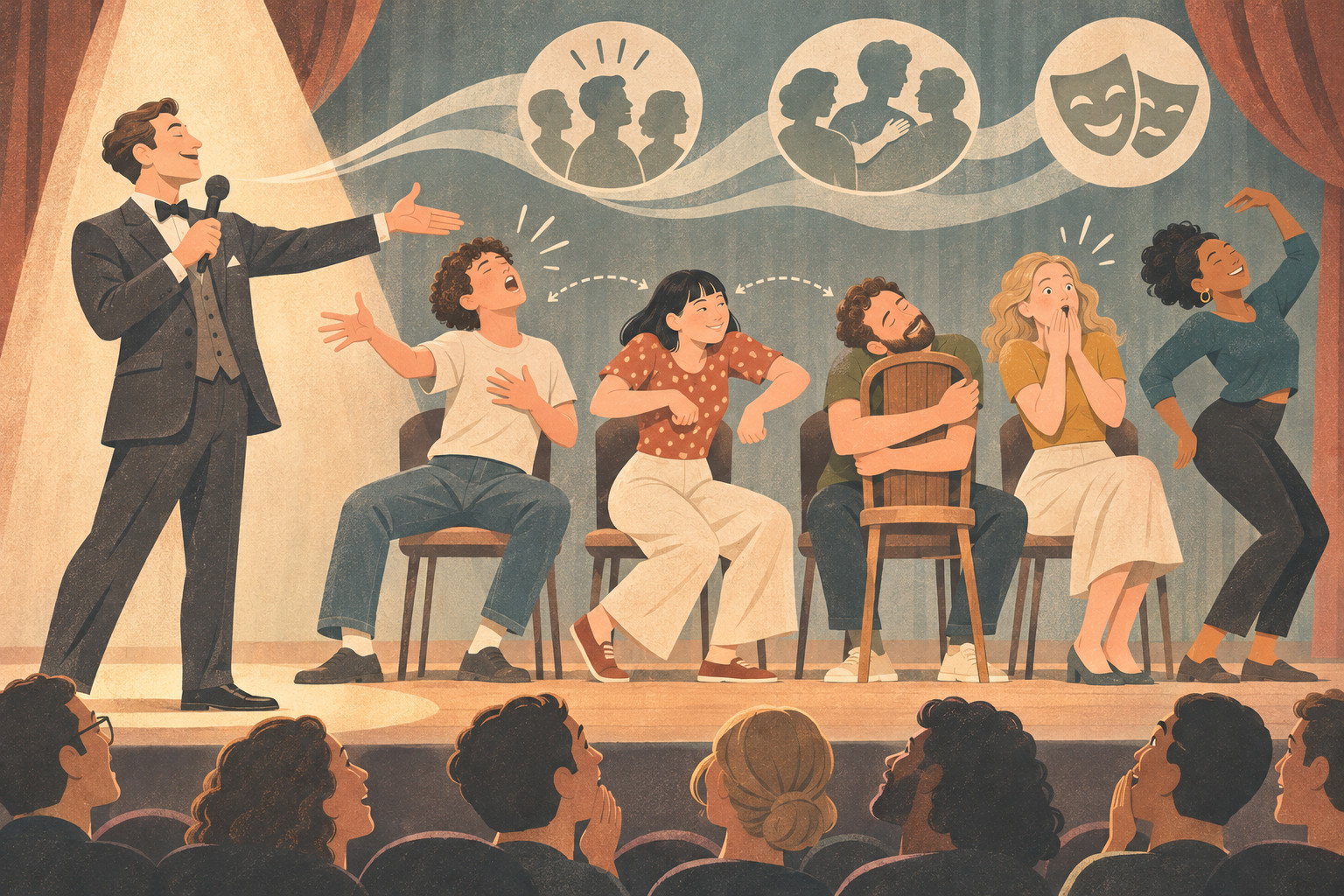
I worked with professional stage hypnotists on the nightclub circuit. We were doing as many as three shows a week, and I saw hundreds of performances from behind the scenes. I even went onstage myself on numerous occasions.
The biggest secret of the business is that you don’t necessarily have to hypnotize anyone to put on a convincing hypnosis show. You just need to understand human nature.
There’s a reason we always wanted 30 or 40 volunteers onstage at the beginning of a performance. We knew that only a small percentage of those people would be willing to go along with the entire show. The first ten or fifteen minutes were essentially an audition, although nobody in the audience realized it.
The hypnotist would ask people to imagine their hands floating into the air, their eyelids becoming impossibly heavy, or their bodies suddenly falling asleep. These weren’t necessarily tests of hypnotic susceptibility. For us, they were a way of identifying who was willing to play along.
Anyone who laughed at the wrong moment, resisted the suggestions, or simply sat there looking uncomfortable could be sent back to their seat. Eventually, we’d narrow the group down to about 20 percent of the original volunteers.
Those were the people we could build an entire show around.
The participants didn’t know that we knew they were playing along.
That’s what made the whole thing so effective. A person might be sitting onstage pretending to be hypnotized while genuinely believing that the person sitting next to them was experiencing something extraordinary. Meanwhile, that person might be thinking exactly the same thing about them.
Once we had our core group, the suggestions became increasingly ridiculous. We’d have people pretend to be famous singers, perform outrageous dances, become romantically involved with inanimate objects, or react to an audience they were supposedly seeing naked.
People would do things in front of hundreds of strangers that they would never voluntarily do under ordinary circumstances.
But they had been given something incredibly liberating: an excuse.
If everyone believes you’re under someone else’s control, you don’t have to take responsibility for your behavior. You can sing terribly, dance like an idiot, or humiliate yourself in spectacular fashion without worrying nearly as much about what people think of you. As far as the audience is concerned, you couldn’t help yourself.
There was also another powerful psychological mechanism at work. Once somebody had spent twenty minutes pretending to be hypnotized, admitting they had been faking it became considerably more embarrassing than simply continuing.
And if someone did decide to stop participating halfway through the performance, we had an explanation ready. We’d remove them from the stage and tell the audience they’d come out of hypnosis.
If somebody followed the hypnotist’s instructions, it meant the hypnosis was working. If somebody stopped following them, it meant the hypnosis had worn off.
The hypnotist could never be wrong.
Sometimes, we planted people in the audience.
On particularly slow nights, I would recruit friends to participate in the show. They knew exactly what they were doing. They weren’t experiencing an altered state of consciousness or some overwhelming compulsion to follow instructions. They were deliberately performing.
I did it myself, too. And what’s particularly funny is that for years afterward, I refused to admit that I’d been pretending. Some of the things I’d done onstage were so embarrassing that it was much easier to let people believe I’d actually been hypnotized than to admit I’d willingly made a fool of myself.
That’s another reason I take stories about people not remembering what they did onstage with a grain of salt. There’s a considerable social incentive to maintain the illusion after the performance ends.
People also tend to assume that because somebody’s reaction looks genuine, the hypnosis must be genuine. But the emotions themselves often are real. The embarrassment is real. The excitement is real. The laughter is real. Ordinary people don’t necessarily need to be talented actors to produce convincing reactions when they’re caught up in an entertaining situation.
Now, I want to make an important distinction. I have no formal training in clinical hypnosis, and I’m not claiming that hypnosis cannot produce legitimate psychological or physiological effects. I also can’t tell you with absolute certainty what every volunteer was experiencing internally.
What I can tell you is that we were capable of producing extraordinarily convincing hypnosis shows with people who were fully conscious, completely aware of what they were doing, and deliberately playing along.
And despite everything I’ve revealed, I still have an enormous amount of respect for the performers I worked with. They were incredibly skilled at reading people, managing a crowd, and understanding the subtle social pressures that influence human behavior. I’ve watched audiences practically cry with laughter.
Knowing how the trick works hasn’t made it any less entertaining to me. If anything, I’ve come to appreciate the psychology behind it even more.
Because the most remarkable thing about stage hypnosis isn’t that someone can supposedly take away your free will.
It’s how little they need to do to convince everyone that they have.
Was this worth your time?
What missed? (optional)