
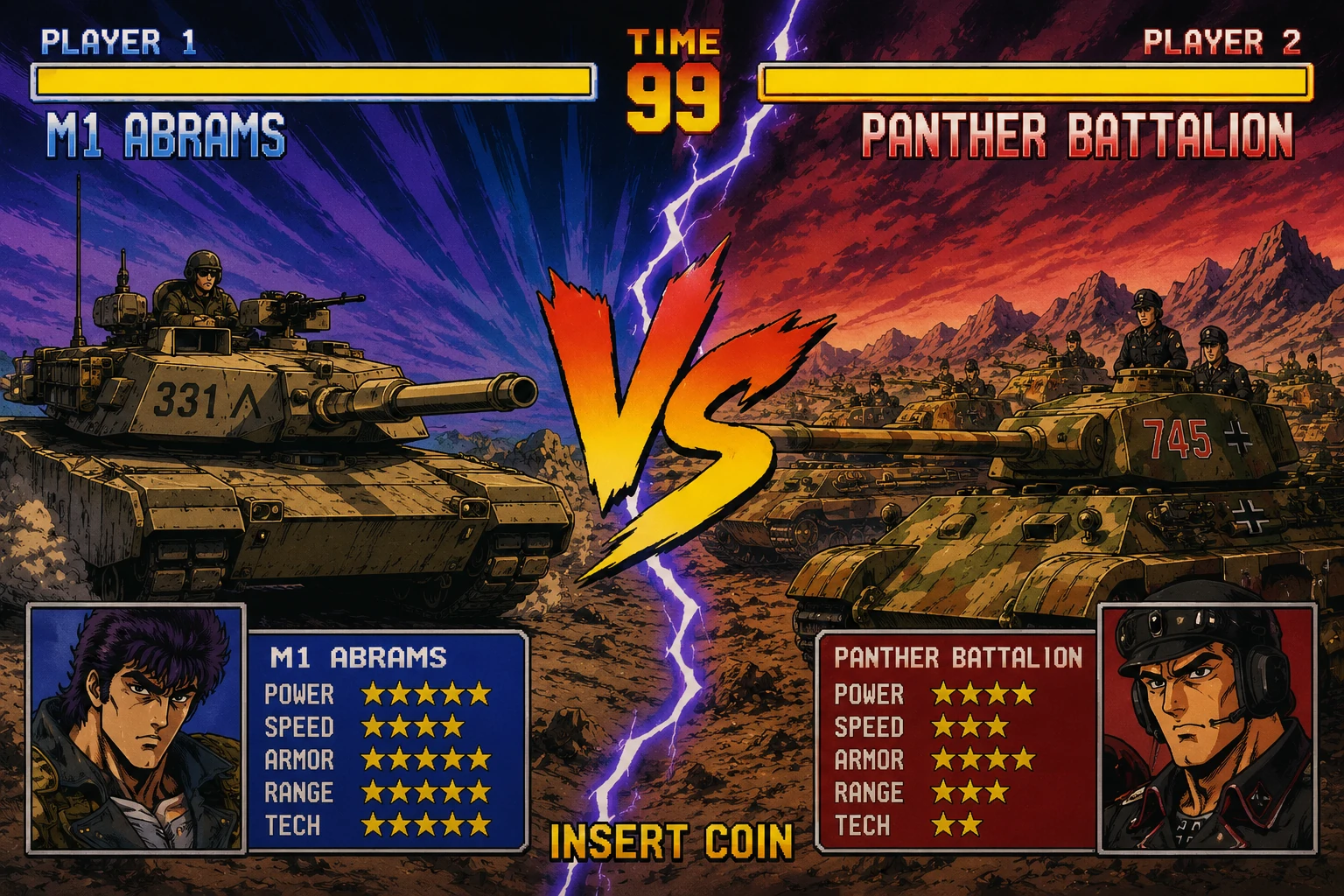
For nearly eighty years, the Panther has occupied a mythical place in military history.
Ask someone to name the greatest tank of World War II, and chances are they will say the Tiger. Ask historians, though, and many will quietly point to the Panther instead.
Introduced in 1943 after Germany’s rude awakening against the Soviet T 34, the Panther was not designed to be the biggest tank on the battlefield. It was designed to be the best balanced.
Its long barreled 75 mm KwK 42 gun could punch through Allied armor at astonishing distances. Thick, sharply sloped frontal armor made it difficult to destroy from the front. Excellent Zeiss optics gave German gunners some of the clearest views on the battlefield.
Against almost anything the Western Allies fielded in 1944, the Panther was a predator.
Now imagine dropping forty eight of them, the strength of a typical late war battalion, onto a modern battlefield.
Across the valley sits a single M1A2 Abrams.
No artillery.
No helicopters.
No drones.
No infantry.
Just one Abrams versus an entire battalion of Germany’s finest tanks.
Could it actually win?
The answer depends on whether you think tank battles are decided by steel or by information.
The Abrams Does Not Fight Like a World War II Tank
One of the biggest misconceptions people have is that tanks evolve by getting thicker armor and bigger guns.
That is only part of the story.
The real revolution happened inside the turret.
The Abrams is not simply a bigger tank with a bigger gun. It is the culmination of more than eighty years of hard earned battlefield lessons. Every major conflict, from World War II and Korea to Vietnam, the Cold War, and the Gulf War, forced military planners to rethink what a tank needed to survive. Crews discovered that thicker armor alone was not enough. Bigger guns were not enough. Even speed was not enough.
Every major component of the Abrams exists because someone, somewhere, paid for that lesson in blood.
Its composite armor is the answer to increasingly lethal anti tank weapons. Its fire control computer was designed to eliminate the split second delays that often determined who fired first. Its thermal sights came from the realization that battles do not stop when the sun goes down. Its stabilized gun allows accurate fire while moving because armies learned that stopping to shoot often meant becoming the easier target.
The Abrams is less a single machine than the accumulated experience of generations of armored warfare. Every sensor, every electronic system, and every piece of armor reflects decades of asking the same question: How do you give your crew one more second to see first, shoot first, and survive?
That is why comparing an Abrams to a Panther is not simply comparing two tanks. It is comparing a machine built at the height of World War II to one designed after decades of studying, and learning from, that very war.
A Panther commander fought with his eyes. He scanned the horizon through excellent but ultimately conventional optics, estimated range through experience, issued commands over the intercom, and hoped his gunner landed the first shot.
An Abrams crew sees the battlefield in an entirely different way.
Thermal imaging does not care whether it is noon or midnight. A tank hidden in shadows, camouflaged behind trees, or sitting in light fog still glows with heat. The gunner is not searching for the outline of a tank. He is searching for an engine that is hundreds of degrees hotter than its surroundings.
Then comes the laser rangefinder.
Instead of estimating that a target is roughly 1,800 meters away, the Abrams knows the exact distance almost instantly. Its ballistic computer calculates elevation, lead, ammunition type, barrel wear, crosswind, air temperature, and even how the tank itself is moving.
The gunner is not making educated guesses.
He is confirming what the computer has already solved.
The result is devastating.
While a Panther crew is still determining the range, the Abrams has already fired.
The First Shot Is Usually the Last Shot
The Abrams’ M256 120 mm smoothbore cannon fires ammunition that would look like science fiction to a German tank crew.
Its primary anti tank round is an APFSDS, which stands for Armor Piercing Fin Stabilized Discarding Sabot. Instead of a large explosive shell, it launches a long, dense dart made of depleted uranium or tungsten at roughly 1,600 to 1,700 meters per second, well over 5,000 feet per second.
The projectile does not explode.
It simply strikes with so much concentrated kinetic energy that armor fails catastrophically.
A Panther’s 80 mm sloped glacis was one of the finest armor designs of the Second World War. Against the guns of 1944, it was formidable.
Against a modern sabot round, it offers virtually no meaningful protection.
Any Panther hit in the center of its hull would almost certainly be destroyed.
The engagement would likely happen at ranges where the Panther crew never even saw who fired.
Moving Does Not Save You
World War II tanks generally stopped before firing.
Even the Panther’s superb suspension could not overcome the limitations of wartime fire control technology. Accurate fire while moving was exceptionally difficult, so tank crews typically halted, fired, corrected their aim, and fired again.
The Abrams changes the equation.
Its gun is fully stabilized, allowing accurate fire while moving over rough terrain at speed. Combined with its fire control system, this means the Abrams can relocate between shots without sacrificing much accuracy.
To a Panther commander, it would seem almost impossible. An enemy tank could race across the battlefield while landing precise hits.
The One Thing Even the Abrams Cannot Escape
Here is where the fantasy begins to collide with reality.
An Abrams is not a video game tank with unlimited ammunition.
It carries roughly 40 to 42 rounds in the turret bustle and hull, depending on its configuration and ammunition load. Not all of those are armor piercing sabot rounds. A real combat load also includes multipurpose ammunition intended for bunkers, infantry, and other targets.
Even assuming exceptional marksmanship, ammunition becomes the first hard limit. A battalion of Panthers numbers around 45 to 60 tanks. A missed shot, a mobility kill that requires a second round, or a particularly unlucky engagement starts eating into that reserve.
Fuel is another constraint. The Abrams’ 1,500 horsepower gas turbine gives it outstanding acceleration, but it also consumes fuel at a rate that would astonish a World War II crew.
Modern armored formations survive because fuel trucks, maintenance teams, and recovery vehicles stay close behind them.
Strip all of that away, and even the world’s best tank becomes a machine with a clock ticking over its shoulder.
So Who Wins?
If the fight consists of a series of long range engagements across open terrain, where the Abrams can exploit its superior sensors, armor, stabilization, and fire control, it would almost certainly destroy Panthers one after another with frightening efficiency.
The technological gap is simply too large.
But destroying an entire battalion is a different challenge.
Eventually, the Abrams must contend with limited ammunition, limited fuel, mechanical wear, and the simple reality that dozens of enemy tanks can maneuver, disperse, and attack from multiple directions.
A single machine, no matter how advanced, cannot replace the logistics and support of an armored force.
The real lesson is not that modern tanks are invincible.
It is that warfare has become a contest of systems. The Abrams is extraordinary not just because of its armor or its gun, but because it belongs to a network of reconnaissance, communications, maintenance, logistics, and combined arms support. Remove that network, and even history’s most capable tanks begin to inherit the same limitations as their predecessors.
The Panther was one of the finest tanks of its era. The Abrams is one of the finest of ours. Put them face to face, and the Abrams holds every meaningful technological advantage. Ask it to fight an entire battalion alone, though, and the question shifts from whether it can destroy a Panther to how long any tank can fight without an army behind it.