
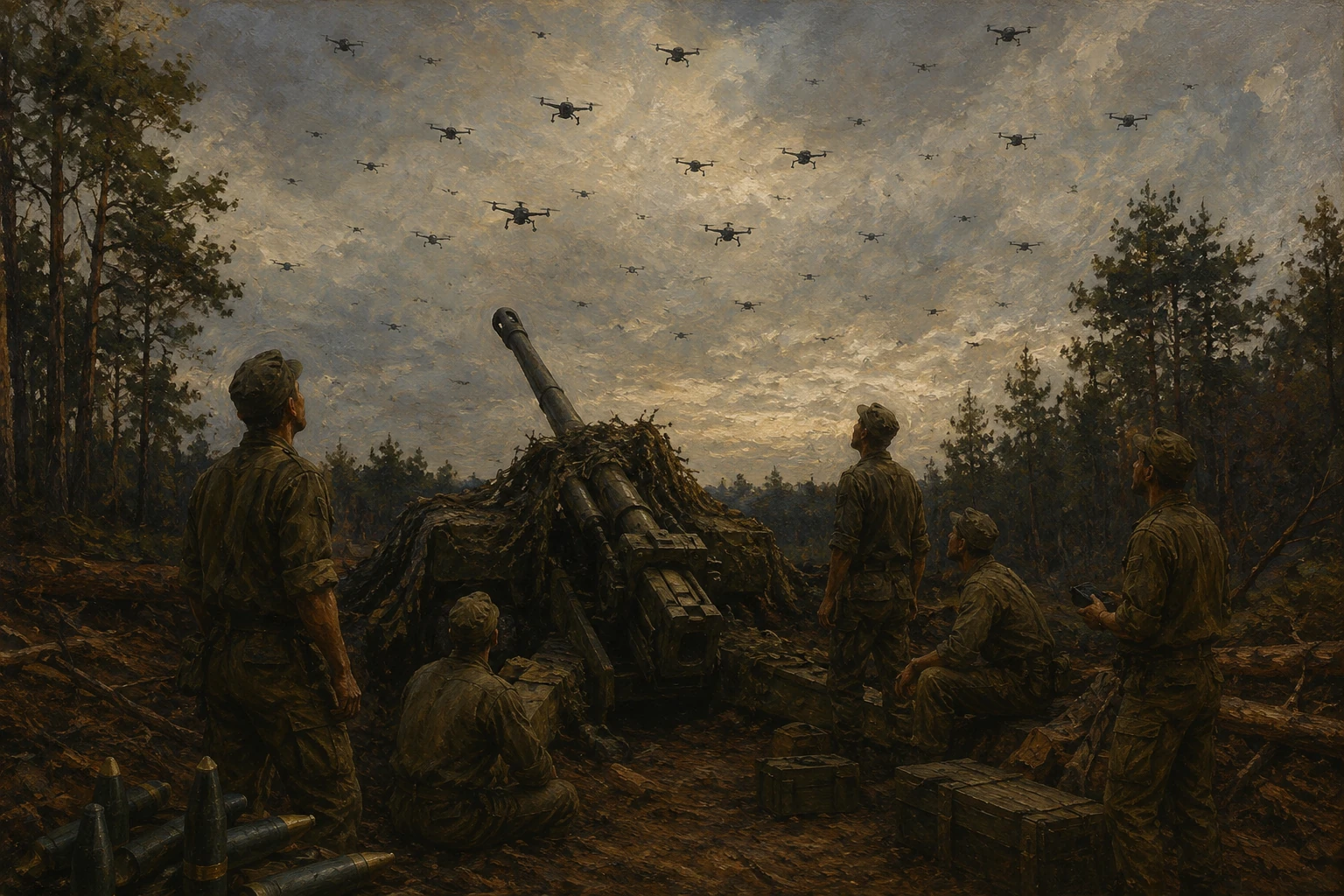
I am thirty-eight years old. Before the war, my life revolved around international trade, contracts, shipping schedules, and the ordinary frustrations of office work. Military service wasn’t supposed to define my life. I served years ago as a mortar operator, returned to civilian life, and thought that chapter was over. Then history decided otherwise.
When Russia launched the full-scale invasion, I put the suit back in the closet and traded spreadsheets for artillery.
People often imagine artillery as it existed in the documentaries: giant guns firing from miles behind the front while spotters call corrections over the radio. That picture belongs to another era. The battlefield I live on today is almost unrecognizable from the one we trained for. Every lesson we learned before this war has been rewritten by drones.
The first thing you notice near the front isn’t explosions. It’s the sound.
People expect constant shelling, but what stays with you is the buzzing. FPV drones are always somewhere overhead. Sometimes they’re yours. Sometimes they’re Russian. Sometimes you don’t know whose they are until it’s too late. There are moments when the buzzing never really stops. It becomes background noise like traffic in a city, except every engine in the sky might be hunting someone.
Many people still talk about “shoot and scoot” as though it’s the gold standard of artillery doctrine. Fire your mission, immediately move, avoid counterbattery fire. It sounds sensible in a classroom. It sounds smart in military journals.
Reality is different.
Movement gets you noticed.
A stationary gun hidden inside a carefully prepared bunker of logs, dirt, camouflage, and weeks of hard labor is surprisingly difficult to destroy. A gun driving across open terrain becomes visible to every drone searching overhead. Once they find you, they don’t have to guess where you’ll be. They follow.
People think mobility equals survival.
Sometimes mobility is exactly what gets you killed.
That has been one of the strangest lessons of this war. We spend enormous effort staying invisible rather than staying mobile. Patience has become a weapon.
The same transformation happened to artillery observers. When I first served, observers were among the most important people on the battlefield. They crawled into dangerous positions with binoculars and radios, watching enemy movements and adjusting fire.
Today?
A man standing in an observation post is often just another target.
The cameras don’t get tired. The drones don’t blink. Electronics replaced jobs that once required extraordinary courage. That doesn’t make the battlefield safer. It just changes who carries the risk.
People also ask whether artillery still matters.
Of course it does.
But we’re no longer the king of the battlefield.
If weather grounds drones or electronic warfare blinds them, artillery becomes essential again. If a bunker has to disappear or a reinforced building has to be cracked open, that’s our job. But if you ask frontline soldiers what they’d rather have over their heads on a clear day—a battery of guns or dozens of FPV drones—I already know the answer.
The drones arrive first.
We have become the heavy backup rather than the main event.
That realization is humbling.
Everyone likes to imagine the weapon they trained on will always remain decisive. History rarely grants that wish.
People often ask if Russia is running out of equipment, ammunition, or fuel. From where I stand, those questions miss the point. Whatever shortages exist, the frontline receives priority. If there is one truck of fuel left, it goes to combat units before anyone else. Hoping your enemy collapses because of logistics is comforting. Planning as though they won’t collapse is what keeps you alive.
Another misconception is that technology solves everything.
People hear about shells that fly seventy kilometers or artillery systems capable of firing while moving and assume every innovation changes the war. The first question I ask isn’t how far something shoots.
I ask how accurately.
Then I ask whether GPS still works after Russian electronic warfare starts doing its job.
The brochure and the battlefield often tell different stories.
None of this means I have become cynical.
If anything, I’ve become practical.
War strips away fashionable ideas very quickly. Whatever survives contact with reality becomes doctrine. Everything else becomes PowerPoint slides.
The hardest part isn’t actually the enemy.
It’s endurance.
Vehicles break constantly. Mud, dust, rough terrain, endless movement—they destroy engines and suspensions faster than factories can replace them. Repairs consume an unbelievable amount of time. Sometimes the most valuable contribution someone can make isn’t firing another shell but getting another truck running again.
People imagine soldiers thinking constantly about victory, politics, or history.
Most days we’re thinking about batteries that need charging, vehicles that need fixing, ammunition that has to arrive, and whether everyone makes it back from the next supply run.
You can’t live at maximum emotion forever.
The routine keeps you alive.
When people ask why Ukrainians continue fighting, I don’t have one simple answer. There are political reasons. Historical reasons. Personal reasons.
But there’s another reason that’s harder to explain.
When someone tells you your country shouldn’t exist, when they invade because they believe your choices belong to them, eventually the argument stops being theoretical.
You fight because someone has decided your future isn’t yours anymore.
That tends to clarify priorities.
I’ve been close enough to death to believe I wouldn’t survive. I remember being shelled near Donetsk years ago. I remember being called back in 2022 wondering if I was leaving for the last time. Those memories don’t disappear. You simply learn to carry them.
People sometimes call us heroes.
I don’t really think about it that way.
I’m just one artillery officer among thousands doing a job that someone has to do. There are soldiers far braver than me. Commanders carrying heavier burdens than mine. Mechanics who somehow keep impossible machines running. Drone operators changing warfare one flight at a time.
When this war finally ends, I don’t dream about another military career.
I want to leave.
I want to return to civilian life, complain about office meetings, worry about deadlines instead of artillery ranges, and rediscover all the boring problems that once seemed important.
Those ordinary problems would feel like a luxury.
Until then, we adapt.
Every week the battlefield teaches another lesson. Every month another assumption dies. Every year the manuals become a little less relevant.
Wars are often remembered by the weapons they introduced.
I suspect this one will be remembered for making everyone realize that the sky is never empty anymore.