
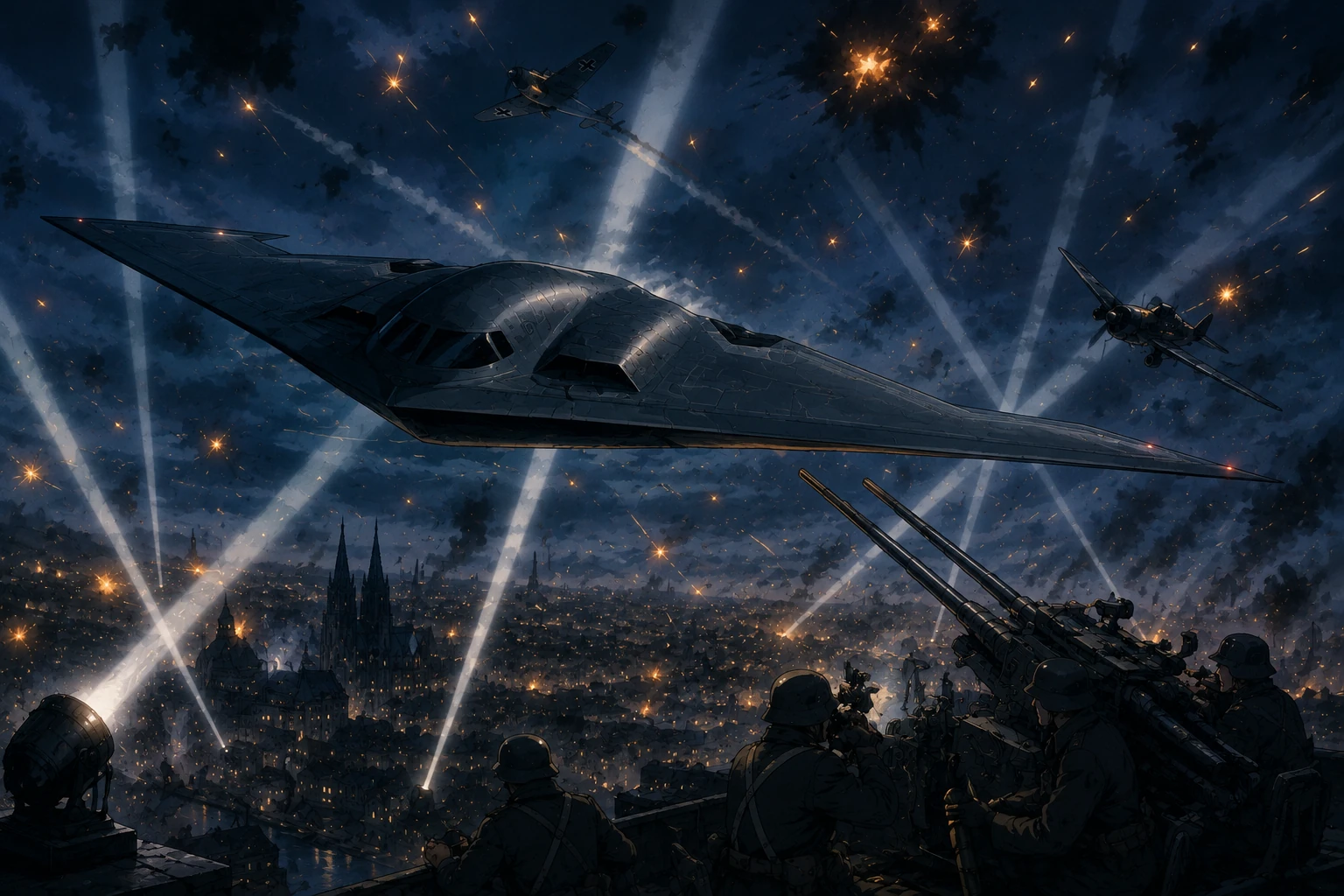
Imagine waking up on an airfield in Germany in 1944.
Radar operators are tracking a contact unlike anything they have ever seen. It is flying high. It is fast enough to be unusual, but not impossibly so. It does not travel in formation. There are no escort fighters. No bomber stream stretching across the horizon.
Just one aircraft.
Within hours, anti aircraft batteries are alerted. Fighter squadrons scramble. Searchlights begin scanning the night sky.
Somewhere above them, a B-21 Raider is already approaching its target.
Could every air defense available during World War II stop America’s newest stealth bomber?
The answer reveals just how dramatically air warfare has changed over the last eighty years.
World War II Was Built Around Finding Bombers
The greatest challenge facing any bomber has always been survival.
During World War II, survival usually meant flying in large formations.
American B-17s and B-24s packed themselves together because hundreds of machine guns created overlapping fields of fire. Fighter escorts protected them whenever possible, while navigators carefully followed predetermined routes toward their targets.
The defenders knew this.
German radar stations detected incoming raids from long distances. Controllers directed fighters toward the bomber stream. Once visual contact was made, aircraft like the Bf 109 and Fw 190 attacked repeatedly while thousands of anti aircraft guns filled the sky with exploding shells.
The entire defensive system depended on one assumption.
You could find the bombers.
The B-21 changes that assumption before the battle even begins.
The Hardest Target Is the One You Never Detect
The B-21’s greatest weapon is not its payload.
It is uncertainty.
Unlike conventional bombers, the Raider is designed from the very beginning to reduce how much radar energy reflects back toward the receiver. Every angle, every curve, and every surface exists to make detection more difficult.
World War II radar was revolutionary for its time, but primitive by modern standards.
Early warning systems often operated at relatively low frequencies and produced only rough estimates of range and bearing. Operators frequently struggled to distinguish aircraft from weather, terrain, or electronic interference.
Against a large formation of hundreds of bombers, that was enough.
Against a single aircraft specifically designed to minimize its radar signature, the picture becomes much less certain.
The operators might detect something.
They might not know exactly where it is.
More importantly, they may never know where to send their fighters.
Fighters Cannot Shoot What They Cannot Find
Suppose German radar somehow notices an unidentified contact.
The next step is interception.
This is where the problem grows dramatically.
Aircraft such as the Messerschmitt Bf 109, Focke Wulf Fw 190, or even the jet powered Me 262 relied almost entirely on ground controllers guiding them into visual range.
Once there, pilots searched with their own eyes.
That works surprisingly well against a box of one hundred silver B-17s.
It is far less effective against a single dark flying wing with a much smaller visual profile.
Even if the B-21 were eventually spotted, the interception window could be measured in seconds.
By the time a German pilot realized what he was seeing, the Raider could already be disappearing into darkness or cloud.
Flak Was Designed to Blanket the Sky
Perhaps fighters fail.
Then comes the famous German flak.
Cities such as Berlin and Hamburg were surrounded by thousands of anti aircraft guns ranging from light 20 mm cannon to the feared 88 mm gun.
These weapons were extraordinarily effective against bomber formations because they did not need pinpoint accuracy.
Instead, they created enormous volumes of exploding shells that bombers had to fly through.
But flak batteries required accurate predictions.
Fire control crews calculated an aircraft’s speed, altitude, and heading before aiming where the bomber would be, not where it was.
Every error in tracking reduced the chance of a hit.
Against hundreds of bombers, probability worked in the defenders’ favor.
Against one aircraft whose position might never be accurately established, probability suddenly works against them.
The flak crews could fire thousands of shells.
Most would explode harmlessly in empty sky.
Searchlights Become Nearly Useless
Night raids during World War II often turned into surreal battles between darkness and light.
Massive searchlight batteries swept the sky looking for bombers. Once illuminated, anti aircraft guns and night fighters converged.
The system depended entirely on knowing roughly where to point the lights.
If radar cannot confidently track the bomber, searchlights begin searching almost at random.
Finding a single stealth bomber in the night sky becomes like trying to locate a single bird over an entire city using only flashlights.
Electronic Warfare Makes the Gap Even Larger
Even if the B-21 never used its weapons, it carries technology that would seem almost magical in 1944.
Its navigation relies on satellites, inertial guidance, and digital mapping rather than dead reckoning.
Its sensors fuse enormous amounts of information into a single picture for the crew.
Its communications are encrypted.
Its onboard computers process information millions of times faster than anything imaginable during the Second World War.
Modern electronic warfare systems can also detect, analyze, and react to radar emissions in ways that simply did not exist during the era of vacuum tubes.
To World War II defenders, it would appear less like an airplane and more like something that refused to obey the normal rules of aerial combat.
Could They Ever Shoot It Down?
Nothing built by humans is impossible to destroy.
If a B-21 happened to fly directly through concentrated anti aircraft fire, luck could still produce a hit.
If a fighter stumbled across it visually at close range, cannons remain dangerous regardless of the decade.
Mechanical failures happen.
Pilots make mistakes.
Chance has always played a role in warfare.
But those are accidents.
They are not a reliable defensive strategy.
So Who Wins?
World War II defenses represented the peak of industrial age air warfare.
The B-21 represents the information age.
The difference is not simply better engines or stronger materials.
It is an entirely different philosophy of combat.
The Germans believed victory came from building a defensive network capable of finding bombers and overwhelming them with fighters and flak.
The Raider’s designers spent decades asking a different question.
What if the enemy never finds the bomber in the first place?
Against a conventional bomber, World War II defenses proved they could inflict terrible losses.
Against a B-21, they would likely spend much of the battle chasing ghosts.
The greatest advantage of the Raider is not that it flies faster or carries larger bombs.
It is that the most dangerous fight in air warfare is often the one that never happens.