
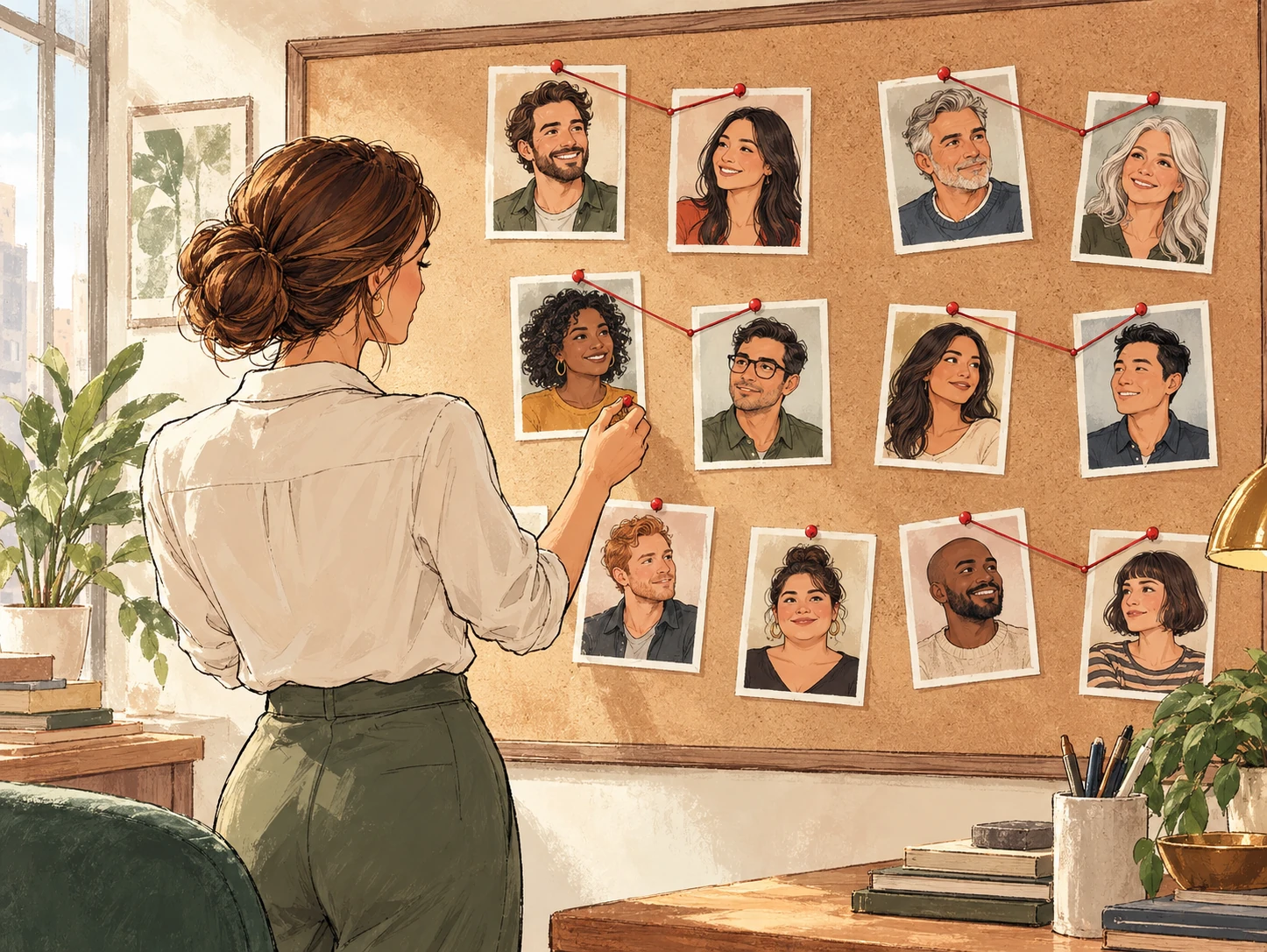
I’ve spent the past ten years working as a professional matchmaker. During that time, I’ve interviewed thousands of single people, listened to both sides of more dates than I could possibly count, and learned that what people say they want is not always the same as what actually makes them happy.
I now run my own matchmaking company, but I started out working for a larger agency. In those early years, I believed good matchmaking was mostly about finding someone who checked the right boxes: the appropriate age, education, career, appearance, religion and lifestyle. Those things still matter, but experience has taught me that compatibility is much more difficult to reduce to a list.
What Actually Makes a Good Match
A great match usually has four basic ingredients: shared values, mutual attraction, compatible lifestyles and the feeling of being understood.
That last ingredient is the hardest to manufacture. People become excited when they meet someone who recognizes a part of them that most people overlook.
I once worked with a woman who had served in the military for 20 years before starting a business devoted to helping veterans heal through holistic methods. I introduced her to another veteran who had also built a business serving the veteran community and was genuinely interested in her work with psychedelics.
They did not simply have a few hobbies in common. They understood the experiences that had shaped each other’s lives. Neither person had to explain why the work mattered so much. That sense of recognition made the match feel different.
One of the most important things I’ve learned is that the person someone imagines as their perfect partner is not necessarily the person with whom they will build the best relationship.
Many clients arrive with a detailed fantasy. They want a specific height, age, income, body type, profession, ethnicity or personality. My job is partly to listen to those preferences, but it is also to determine which ones are connected to genuine compatibility and which are simply protecting a fantasy.
Why Attraction Cannot Be Ignored
Attraction cannot be ignored. I learned that the hard way while working for an agency that arranged strict blind dates. Clients and candidates were not allowed to see one another before meeting.
We could spend hours examining their values and lifestyles, only for one person to walk into the restaurant and immediately know there was no physical attraction.
It often felt like a massive gamble, and most of the time we were not hitting the jackpot. At my own company, both people see photographs before agreeing to a date. It may sound less romantic, but it prevents everyone from wasting time pretending appearance does not matter.
What Men and Women Commonly Look For
Men and women often prioritize different things, although these are broad patterns rather than rules.
Nearly every male client tells me he wants a woman who “takes care of herself.” That phrase usually means he wants someone relatively slim and physically attractive. Appearance tends to rank very high on men’s lists.
Once a man earns more than approximately $200,000 a year, I often find that he cares less about a woman’s degree or job title. He is more likely to emphasize beauty and personality. He wants someone warm, lively, fun and easy to be around.
Women tend to be more flexible about a man’s appearance, with height being the major exception. They frequently pay closer attention to ambition, income, kindness, emotional intelligence and whether he is respected within his community.
Divorced women are particularly likely to prioritize emotional intelligence. They have already experienced the difference between a person who looks good on paper and a person with whom daily life is actually peaceful.
After living through a failed marriage, many no longer care as much about the impressive résumé. They want someone who can communicate, regulate his emotions, take responsibility and handle conflict without making the relationship miserable.
Income matters to many women, but their expectations are generally not as extreme as men sometimes imagine. The idea that only rich men can attract desirable women is simply untrue.
Money can expand someone’s options, particularly in a high-end matchmaking service, but it does not compensate for a lack of social skills, kindness or self-awareness.
How Dating Changes From City to City
Preferences also change depending on the city.
In Los Angeles and South Florida, I encounter a large sugar-dating culture. Older men often want significantly younger women, but they also want me to remove the transactional nature of the arrangement.
That is usually unrealistic. If a man is seeking a woman decades younger primarily because of her youth and appearance, he should not be shocked when she is interested in what his money and lifestyle can provide.
San Francisco clients tend to care deeply about intelligence and professional accomplishment, regardless of gender.
In New York, many women place greater emphasis on a man’s status, while the men are often drawn to women who seem distinctive—artists, travelers or people with a slightly bohemian quality.
How People Reject Themselves
Race affects dating, but my experience has been more nuanced than dating-app statistics suggest. Asian men and Black women have historically received lower response rates on some apps, yet I have successfully matched many people from both groups.
One of my Asian male clients was 5-foot-6, successful, funny and a talented salsa dancer. His first match was a Black woman who was taller than he was. They got along extremely well because she found him interesting.
His height and race did not disappear, but neither prevented attraction once she saw the complete person.
With Black female clients, I noticed that many assumed men outside their race would not be interested in them. At the same time, I would describe these women to white men and repeatedly hear the opposite concern: “She sounds gorgeous, but would she even want to date a white guy?”
Both people were sometimes rejecting themselves on behalf of someone they had never met.
That taught me how much of dating is shaped by anticipated rejection. People tell themselves, “Someone like that would never want me,” and close the door before the other person has a chance to answer.
Do Age Differences Matter?
Age differences are similarly more complicated than a number. What matters is the world that shaped each person.
People from different generations can have very different assumptions about gender roles, marriage, money, sex, communication and adulthood. They may also have different cultural reference points—the music, humor, slang and television that formed their identities.
A ten-year difference may be completely manageable when the couple shares sufficient cultural overlap and is in a similar stage of life.
A much larger gap can become difficult when one person is building a career and considering children while the other is preparing for retirement. Chemistry can be real without eliminating those practical differences.
Why Modern Dating Feels So Difficult
Modern dating has also become more difficult because both men and women now have greater freedom to choose.
In the old system, women often depended on men for financial access and therefore had greater pressure to make themselves desirable enough to be selected. That system was deeply unequal, but the roles were clearly defined.
Women now have their own careers, money and independence. They have become choosers as well. We left the old system behind without fully agreeing on what should replace it.
Both sexes have standards, both can reject the other and neither necessarily needs a relationship for survival.
I see the current turmoil as an adaptation period. Relationships increasingly have to offer something better than independence.
Women are asking men to become more engaged fathers, emotionally capable husbands and genuine contributors to lives that are already full. Some men are adapting to that expectation. Others resent it.
Inside the Matchmaking Business
The matchmaking business attracts people with very different levels of wealth.
My packages begin at $7,000 for Florida residents and include four introductions, a dedicated matchmaker, an initial discovery session and “love blueprint,” screening of every candidate, pre-date calls, date planning, post-date feedback and some coaching.
In established markets such as Los Angeles, San Francisco and New York, clients may pay $25,000 or more.
Interestingly, less wealthy clients are often more emotionally invested in the outcome because the fee represents a significant portion of their resources. They want matchmaking to be the final stop in their search for love.
Wealthier clients are frequently more relaxed. They may view the service as a convenient way to meet suitable people without doing the legwork themselves.
My measurable success rate is approximately 82 percent, meaning both people say after the first date that they would like to see one another again. It is not a marriage rate.
Long-term success is harder to track. Some clients contact me years later to say they got married. Others move in together but never marry, especially older clients who have already been through a divorce.
So far, I have recorded 26 marriages, and I have attended several of the weddings. If a client invites me, I make it a priority to be there.
The Strangest Client Request I’ve Received
Not every request is reasonable.
One male client insisted that his future partner must be able to orgasm through penetration alone. I refused to screen women for that. There was no respectful way to interview a stranger and ask such an invasive question on his behalf.
Part of my responsibility is deciding when a preference crosses the line from compatibility into entitlement.
The Most Disturbing Experience of My Career
The most disturbing incident of my career occurred after a woman went home with a prominent New York entrepreneur following their first date.
The next day, she submitted a five-star review and said she wanted to see him again. He did not submit his feedback immediately. After three days, I told her I still had not heard from him.
She then withdrew her positive feedback and said she could not remember how she had ended up at his home, leading her to believe that he had drugged and sexually assaulted her.
When I contacted him, he denied it and gave a completely different account. It was the only time in ten years that a client accused a match of rape.
The situation showed me that a matchmaker can screen people and arrange an introduction but cannot control what happens between two adults afterward.
The Time I Fell for a Client
I have also had to learn professional boundaries.
My first client was handsome, successful, charming and openly flirtatious. He repeatedly told me that whenever I visited San Francisco, he wanted to take me out for a drink.
He even suggested that if matchmaking did not work out, perhaps I could be the right person for him.
I was smitten. It was a rookie mistake, and fortunately I learned from it.
After a decade in the business, I understand that clients need me to remain clearheaded. I cannot objectively guide someone while secretly hoping to become the person they choose.
Can Artificial Intelligence Replace Matchmakers?
People sometimes ask whether artificial intelligence will replace my profession. I tell them that AI is already attempting to do my job. It is called Tinder.
Dating apps use enormous amounts of data to place people in front of one another, yet many singles are more exhausted and discouraged than ever. My business has become busier because people want the human element the apps cannot provide.
I do use AI behind the scenes to test how realistic a client’s demands may be.
If someone wants a partner earning more than $500,000 who must belong to one of two racial groups and share an uncommon sexual interest, technology can help estimate how small that pool becomes.
That information allows me to have an honest conversation with the client—or decline to represent someone I am unlikely to match.
But a probability calculation cannot tell me whether two people will feel seen by one another. It cannot fully recognize when someone’s supposed “type” is part of a destructive pattern.
It cannot sit with a person after a disappointing date and help separate genuine incompatibility from fear.
What I Tell People Who Want a Relationship
The best advice I can give anyone looking for a relationship is to begin by understanding their own relationship with love.
Learn your attachment patterns. Think about how affection was given or withheld during childhood. Did you have to perform, please people or become someone else to feel worthy of love?
Are you repeatedly choosing partners who recreate the same emotional conditions?
Self-awareness does not guarantee a healthy relationship, but without it, people often navigate blindly and call the repetition fate.
It is equally important to be honest about what you want. Too many people claim they are “just going with the flow” because they are terrified of appearing eager.
If you want a meaningful relationship, say so. You do not have to demand commitment on the first date, but you should not disguise your intentions to seem desirable.
After ten years, I no longer believe love is about finding someone who perfectly satisfies a checklist.
It is about attraction, compatible lives, shared values and the rare experience of meeting someone who understands a part of you that usually goes unseen.
That is the part no algorithm has learned to manufacture.