
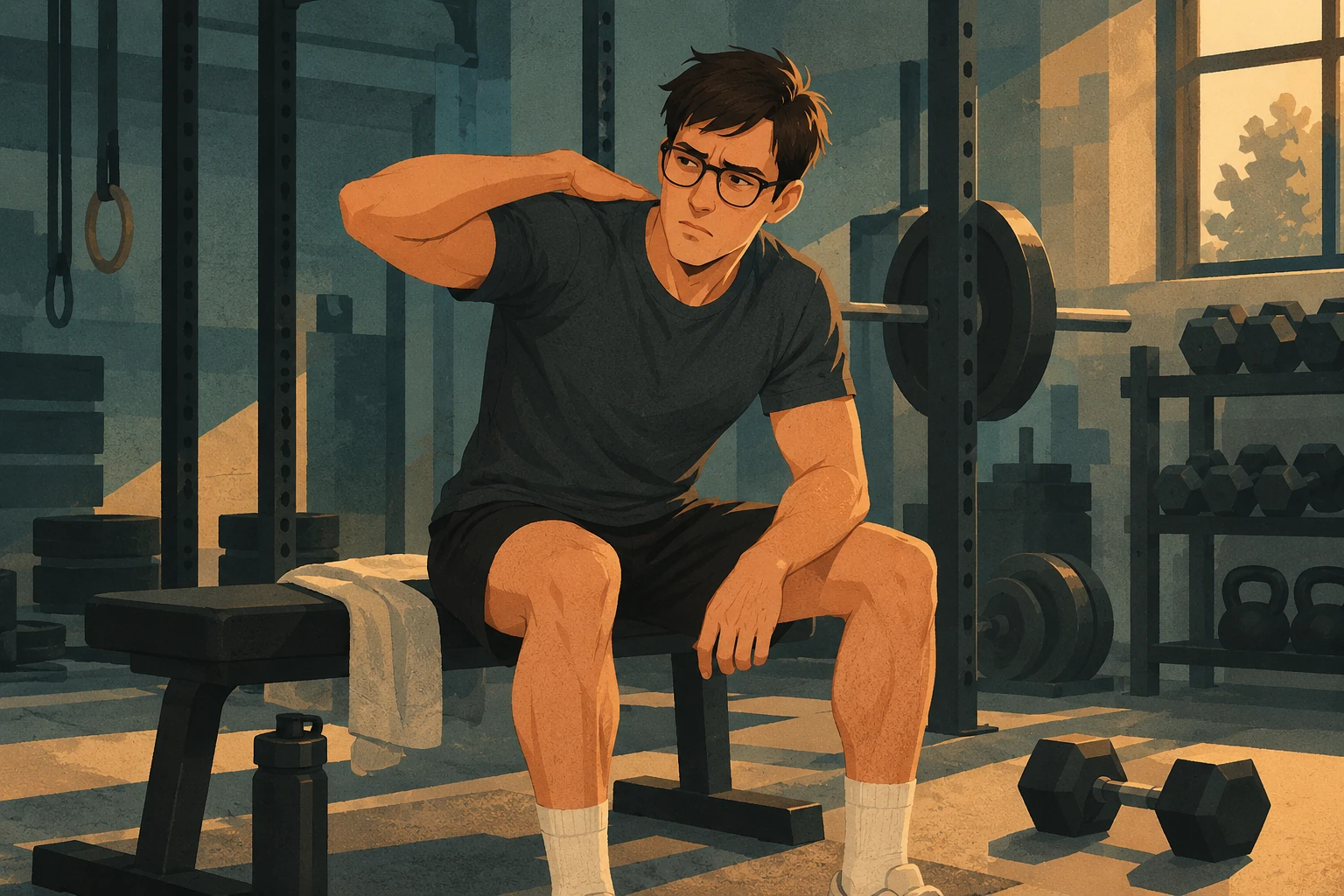
I was 32 years old when I had a heart attack.
At the time, I worked as a personal trainer. I lifted weights regularly. I cycled a lot. I was active enough that having a heart attack wasn’t something that was even remotely on my radar.
The morning it happened started like plenty of other mornings.
I drank some black coffee, smoked some weed, and went into my home gym to work out.
Not long after I started lifting, something felt off.
It’s difficult to explain because it wasn’t the dramatic clutch-your-chest pain I’d always associated with a heart attack. The pain was actually in the back of my right shoulder blade. It felt like someone was pushing a hot poker through me from back to front.
There was also this tightness, almost like I needed to stretch really badly or crack my back.
So I stopped working out.
And waited.
I figured whatever was happening would pass.
It didn’t.
Over the next couple of hours, the pain became progressively worse.
But the strangest symptom wasn’t the pain.
It was the overwhelming feeling that something was very, very wrong.
People sometimes describe a “sense of impending doom” as a symptom of a medical emergency. Before this happened, I don’t think I really understood what that meant.
Now I do.
It wasn’t simply being scared.
It felt like alarm bells were going off inside my body. My brain was telling me that something was seriously wrong and that if I didn’t figure out what was happening, I was going to die.
I didn’t want food. I didn’t want a drink. I couldn’t think about anything else.
There was just this deep sense of dread and an overwhelming urge to figure out what the hell was happening to me.
I’d never experienced anything like it before.
I haven’t experienced anything like it since.
After about two hours, I finally decided I needed to go to the hospital.
I took a Lyft to the ER.
Looking back, taking a Lyft while having a heart attack sounds ridiculous. But at the time, I didn’t think what was happening was serious enough to justify an ambulance.
Obviously, I was wrong.
At the hospital they did bloodwork and an EKG.
Almost immediately afterward, everything changed.
Suddenly a bunch of medical staff rushed into the room.
They told me I was having a heart attack.
I needed surgery.
Now.
“You’re Having a Heart Attack”
The strange thing is that I was pretty calm.
A nurse actually asked me why I was so relaxed about what was happening.
My thinking was basically: I’m surrounded by doctors and nurses right now. This seems like the best possible place to be having a heart attack.
What am I supposed to do, panic?
At one point, someone on the medical team asked me what they could do for me while they prepared everything.
I asked them to go into the hallway and talk to the very confused and frightened young woman who had come to the hospital with me.
They did.
At that point, reassuring my partner seemed more important than reassuring me.
I’d already decided that I was going to stay calm and let the professionals do what they were trained to do.
The doctors eventually discovered that my right coronary artery was completely blocked.
A 100 percent occlusion.
They removed the clot and placed a stent through my wrist.
I spent one night in the ICU and another two nights in the hospital under observation.
And then came the question that bothered me for a long time:
Why did a 32-year-old personal trainer have a heart attack?
Nobody really knew.
Doctors Couldn’t Tell Me Why It Happened
This wasn’t the classic situation where someone had decades of plaque buildup in their arteries.
I didn’t have atherosclerosis. There wasn’t plaque or calcium buildup in the artery. My cholesterol wasn’t particularly high. My LDL was around 90 at the time.
The blockage was caused by platelet aggregation in my right coronary artery, but doctors couldn’t determine why it happened.
And believe me, they looked.
I saw cardiologists, hematologists, rheumatologists and endocrinologists. I underwent genetic testing related to blood clotting.
Nothing.
I wasn’t living like a monk, though.
I drank too much. I’d smoked tobacco for a couple of years in my early 20s, and I was a heavy marijuana smoker from about age 20 until the heart attack.
And there was one other thing: sleep apnea.
During my hospital stay, a night nurse suggested I get tested for it.
She was right. My sleep apnea was bad.
About a month after the heart attack, I got a CPAP machine. I’ve used it every night since, and it completely changed the quality of my sleep.
Could the sleep apnea have contributed? Maybe. Could years of smoking have contributed? Maybe.
My doctors couldn’t say for sure.
Eventually I had to become comfortable with the possibility that I’d never know.
Life After a Heart Attack at 32
For a while after the heart attack, I felt like my fitness had failed me.
I’d spent years getting stronger, lifting weights and riding a bike, and somehow my heart had still nearly killed me at 32.
But my doctors gave me another way to look at it.
They told me my fitness may have been one of the things that saved my life.
I got back to walking pretty quickly and eventually went through cardiac rehab. Today I’m stronger and faster than I was before the heart attack.
I don’t smoke anymore. I drink much less. I use my CPAP every night and take the medications prescribed after my heart attack.
Otherwise, I live my life.
The experience didn’t give me some profound new philosophy. Mostly, it changed a few small things.
I tell the people I love that I love them.
And when there’s something I really want to do, I try not to keep telling myself, “I’ll get to it eventually.”
Because I learned firsthand that being young and feeling healthy doesn’t make you invincible.
I was 32.
I exercised constantly.
I was a personal trainer.
My cholesterol was normal.
I had no plaque buildup in my arteries.
And I was having a heart attack.
If something feels seriously wrong, don’t assume you’re too young or too healthy for it to be an emergency.
I’m glad I finally listened to that feeling.