







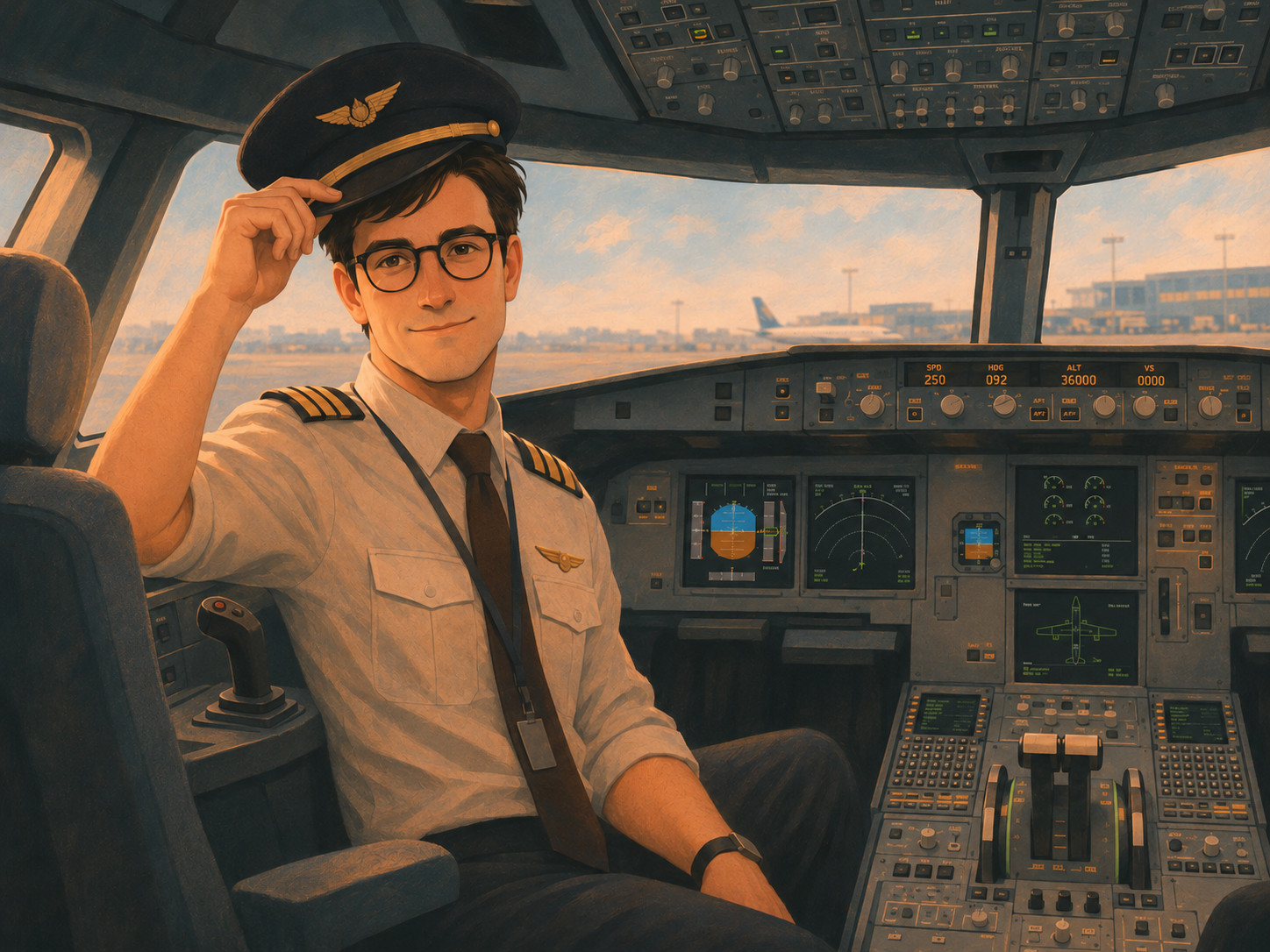
What do pilots actually do during long flights when the airplane is on autopilot?
Yeah, it gets boring. Autopilot is like cruise control on your car. You tell your car how fast you’d like it to go, but it’s not going to change lanes, come off at the exit, navigate around other cars or park itself. This analogy worked better 10 years ago, though.
Same with the plane. I still have to tell it where to go, how high, how fast, etc., and constantly adjust and tweak this for factors like weather, turbulence and other planes.
I talk to my colleagues a lot, read a book or paper, review changes to our operating manuals or read our company newsletter. Obviously, all whilst being hyper-aware of what’s going on at all times.
What do pilots do when everyone onboard is asleep?
Sit smugly in the relief that I don’t need to bother with a cruise announcement that nobody is going to listen to anyway!
In seriousness, our job doesn’t stop. We’re continuing to monitor our systems, navigate to our destination and moan about mortgage rates with our colleague.
Do pilots ever sleep during flights?
On long flights, the two pilots sometimes take turns taking naps. It’s called controlled rest.
Why does the airplane suddenly get quieter shortly after takeoff, and why does it feel like we’re falling?
Two things, usually in relatively quick succession.
A plane doesn’t need quite as much thrust once it’s in the air as it does on the runway. So when we get to about 1,000 feet above the ground, we reduce the engine thrust, which gives you the same body sensation as decelerating in a car, even though you’re not necessarily decelerating in reality.
We also have flaps on the wing which are extended for takeoff. As we climb, we retract these as they’re no longer needed, and when we do that, the nose of the plane lowers. It’s less steeply pointed toward the sky, which gives you another similar sensation in your stomach.
What would you tell someone who is terrified of turbulence?
There are no tricks I can give you, but even when it’s bumpy, the plane is still flying, and the air is still moving over the wing as it’s supposed to. The parcel of air you’re moving through is moving around.
Editor’s note: Commercial aircraft are designed to withstand substantial turbulence, but severe turbulence can cause injuries and, in rare cases, aircraft damage. Keeping your seatbelt fastened while seated is an important precaution.
Can pilots always predict turbulence, or does it sometimes catch you by surprise?
We have written forecasts and some apps at our disposal that help us predict it, but ultimately it’s not something that can be predicted very well.
We can sometimes see weather that we know will be turbulent, so we can try to avoid it. Clear-air turbulence is impossible to see.
It’s generally worse toward the back of the plane than at the front, FYI.
Should passengers be worried when the pilot tells the flight attendants to sit down?
Normally, when we put the seatbelt sign on during turbulence, the crew can continue to work. They’re experienced walking around when it’s not smooth.
Sometimes, if it’s really rough, I’ll make an announcement asking them to be seated too, which freaks people out because they think something is seriously wrong.
Often, it’s just because I want to, and have a responsibility to, make sure they’re kept safe too.
Is a smooth landing necessarily a good landing?
A smooth landing is not the goal. It’s not something that is trained.
The goal is to land the aircraft at the right speed, with the right rate of descent, in the correct place on the runway. A smooth landing is a bonus if you make all of the other things happen first, but it’s not the aim.
There are circumstances, such as on a wet runway, where you actively don’t want a really smooth touchdown, as you need the wheels to make firm contact with the runway.
What’s the most stressful part of flying: takeoff or landing?
Landing. It’s a highly complex maneuver where many, many different factors are trying to get in the way of what you’re trying to achieve.
But like anything, it largely becomes second nature, so it doesn’t really faze us.
How often do airplanes have mechanical issues that passengers don’t know about?
Every day there’s something.
Every aircraft type has an MEL document, or Minimum Equipment List, which specifies what equipment can be inoperative and whether that has implications we need to be aware of.
The vast majority of these things have no significant consequences. A handful of things have extra operating procedures or implications we need to follow. A handful of things will legally ground an aircraft from departing until they’re resolved.
How often do mechanical problems get discovered just before departure?
Defects that affect the airworthiness of the plane have to be addressed before departure. It happens commonly.
A quick call to the engineers, they do their thing and sign to say it’s sorted, and then we’re good. Passengers are often oblivious to it happening.
What’s the worst day you’ve ever had as a pilot?
I had a toilet fire onboard, someone threatened they had a bomb, and an engine issue all happen on the same day.
What’s the most challenging emergency a pilot could face?
Outside of both engines shutting down, which is extremely unlikely, a total electrical failure onboard is probably the most challenging, I would say.
Passenger issues are also really hard.
Having flown both Boeing and Airbus aircraft, which do you prefer?
In my opinion, Airbus is superior to fly. It’s ergonomically and psychologically designed to make my job as intuitive as possible.
Do pilots need a different qualification for each type of airplane they fly?
Yes. A manufacturer’s different models of plane all look fairly similar, but not identical. Different manufacturers have different cockpit concepts, Airbus versus Boeing being an obvious one.
You get your qualification for a specific model of plane called a type rating. Usually, you only hold one at a time and will change your type rating when you move to a different type of plane.
How do pilots communicate with air traffic controllers in foreign countries?
English is the international language of aviation.
Other languages are also used with air traffic control where permitted in relevant countries. In France, for instance, French-based crews often speak to air traffic control in French. Despite this, English is available for international operations.
What are some of the most challenging airports to land at?
Innsbruck, Funchal and Gibraltar are all particularly challenging.
Is it okay for passengers to get up, walk around and stretch during a long flight?
It’s a balance. The galley areas are working environments and, especially on smaller aircraft, that small square is the only private space the cabin crew have to do almost all their work, take a break and eat their dinner.
Stretching here for 30 seconds isn’t going to hurt anyone, but it’s not good practice to go and stand there for five minutes. The majority of crew wouldn’t say something if you did, mind.
Can passengers still ask to visit the cockpit?
Never in flight. On the ground, they’re welcome and encouraged when we are not busy.
What’s one of the biggest misconceptions people have about pilots?
That there’s one pilot and one co-pilot. There are two or more pilots, of which one is a captain and the other or others are first officers. Both are pilots.
What surprises you most about your job?
How 75% of passengers act like it’s their first day on Earth and lose all common sense and ability to act rationally.
How do you feel about passengers applauding after a landing?
Half of me thinks it’s really cringe, and half of it makes me feel warm inside.
When you fly as a passenger, can you actually relax, or are you mentally flying the plane?
I simultaneously relax and judge everything at the same time.
Is it ever too late in life to become a commercial pilot?
I know people who started in their late 40s. Mid-to-late 40s is probably what I’d suggest as a practical upper limit.
Do you have much of a life outside of flying?
Yeah, I definitely do. I work fewer days than the majority of my friends.
I’d like to step down to part-time later in life, so going to work flying becomes the hobby and my life outside is full of holidays and good food.
Do you still love flying? What’s your favorite part of the job?
I love it when it goes well. It’s really, really difficult when it goes wrong.
My favorite thing is that no matter what the weather is doing on the ground, it’s always sunny above the clouds.
I will always feel so privileged to get that experience regularly.
Was this worth your time?
What missed? (optional)