

Can you tell us a little about yourself and where you grew up?
I’m 21 years old, and I live in Bosnia and Herzegovina, in the Balkans. I grew up here, and I’m very connected to my country’s culture, but I also cherish my Romani roots and history.
I’ve met Romani people from different parts of the world, and there are a lot of differences between our communities. Sometimes I think it would be interesting if we had our own country. Maybe people would be less judgmental and more familiar with us.
But I’m happy living in Bosnia. Our history has been about living alongside other nationalities and cultures.
What is the biggest misconception people have about Romani women?
That we’re uneducated, that we have to get married young, and that we’re expected to leave school.
I remember a friend from elementary school asking me if I was going to get married when I turned 13. That’s one of the reasons I wanted to answer questions about my culture.
People have a certain image of Romani women, and when you don’t fit that image, they sometimes can’t believe you’re actually Romani.
Was education encouraged in your family? Were you expected to marry young?
My parents didn’t want me to get married right after high school. They wanted me to continue my education or find work.
I’m also a member of a Romani NGO that helped me build my confidence and encouraged me to participate in projects and attend university while still preserving my traditions and culture.
In my town, education is highly encouraged. There are scholarships, workshops, mentors, and Roma mediators who work directly with families. They explain the importance of education and sometimes even provide school supplies and food.
I recently married the man I love, and I’m still attending university. Nobody pressured me into getting married. It was my decision, and I’m happy.
Is early marriage still common in Romani communities?
It really depends on the community and the country.
In my community, underage marriages are uncommon, and I personally don’t know any girl who was forced to marry. But I’m aware that child marriage remains a problem in some Romani communities around the world.
I’m not denying that these problems exist. I’m saying that our communities are different, and things are changing in some places.
What role does religion play in Romani culture?
Romani people often practice the religions of the countries and communities around them.
I’m Muslim because I grew up in Bosnia, where Islam is an important part of society. But I have relatives in other cities who are Christian, and we get along perfectly well.
I’ve also met Romani people from different countries who are Catholic, Orthodox Christian, atheist, and so on.
There isn’t one religion that defines all Romani people.
Do Romani people have their own language?
Yes! We have our own language, Romani, although there are different dialects.
I speak Bosnian, English, and German fluently. I can also communicate to varying degrees in Romani, Spanish, French, and Italian.
Unfortunately, in my community, it’s mostly older people who speak Romani fluently. I’m not fluent myself, but I know enough words and phrases to have a basic conversation.
One time I met someone and we couldn’t communicate in English, German, French, Spanish, or Italian. Then, almost as a joke, I asked, “Đane Romane?” which means “Do you speak Romani?”
And suddenly we could understand each other!
I wish more young people would learn our language. It’s such an important part of our identity.
What are some Romani holidays and traditions that people might not know about?
One of our holidays is Ederlezi, or Djurdjevdan, celebrated on May 6. It marks the arrival of spring and the beginning of a season associated with traveling, working, and spending time outdoors.
We have traditions like bathing in rivers with flowers, rubbing red eggs on our skin for good luck and health, and gathering around bonfires. Some people jump over the fire as a symbol of purification and a new beginning.
Another holiday is Alidjun, celebrated on August 2. It represents the opposite part of the seasonal cycle, when traveling and outdoor work begin winding down.
Both holidays involve big meals, music, trumpet players, family gatherings, and lots of fun.
What’s your favorite thing about Romani culture?
The importance of family, our hospitality, and how much we love gathering together.
We spend a lot of time singing, dancing, and celebrating. I love the energy of our music and the emotions Romani singers put into their performances.
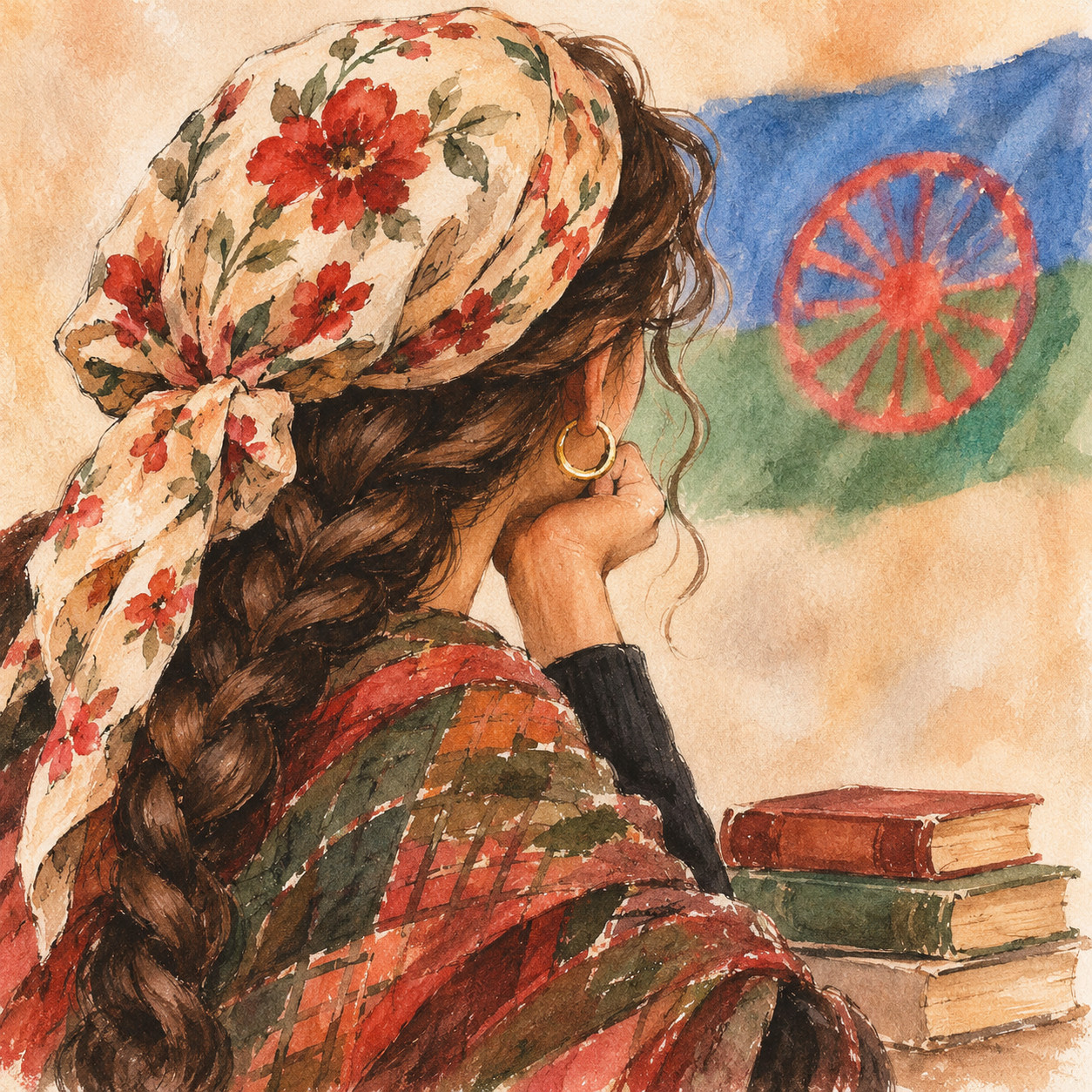
I’m also proud of our history and our flag.
Our flag is blue and green with a wheel in the middle. Blue represents the sky, green represents the earth, and the wheel symbolizes our history of migration and movement.
To me, it represents freedom and our ability to maintain our identity wherever we live.
What kind of discrimination have you experienced personally?
Both personal and systemic discrimination.
When I was in school, children would laugh at me and call me names. But one of the most frustrating things was how people couldn’t understand that I could be educated, clean, and live a normal life while still being Romani.
People have actually asked me if I’m sure that I’m Romani.
It’s like, if I don’t fit the image you have in your head, then I can’t possibly be who I say I am?
These attitudes have very deep roots, and it’s going to take a lot of time and work to change them.
Why do you think Romani people are so often associated with stealing and crime?
Romani families have historically been marginalized and socially excluded. When you’re constantly judged, denied opportunities, and have difficulty finding employment, it can push some people toward criminal activity.
That doesn’t mean stealing is part of our culture. It isn’t.
I’ve never stolen anything, and I don’t believe criminal behavior should be associated with an entire ethnicity.
When people grow up in unhealthy environments with limited opportunities, problems can develop regardless of their background.
What about Romani communities that remain separated from the rest of society?
There are still communities where Romani people live almost exclusively among themselves, often in very poor conditions.
Some neighborhoods have terrible roads, inadequate services, and even problems getting waste collection.
In my town, however, there have been considerable efforts to promote inclusion.
My own family received assistance with legalizing our home after my parents were finally financially stable enough to buy one. Various Romani organizations helped us through the process.
These organizations also support education, employment, and integration, although there is still a lot of work to be done.
Why do some young Romani people hide their identity?
Because of the judgment they face.
Even some members of my extended family don’t want to tell people they’re Romani. They would rather distance themselves from their background than deal with discrimination.
It makes me sad because I think we should be proud of who we are.
I understand why some people feel that way, but I don’t want to hide my identity.
How do you feel about the word “Gypsy”?
I consider it derogatory, and I prefer Roma or Romani.
Some people within our communities use words like that among themselves, but it feels different when someone outside the community uses them.
What bothers me even more is when someone thinks they’re complimenting me by saying, “You’re not a Gypsy, you’re Romani.”
It’s as if they’re trying to separate me from the stereotypes they associate with my own people.
What do you wish more people understood about Romani people?
That we aren’t all the same.
Romani people live in different countries, follow different religions, speak different languages, and have different traditions.
Some of us are very traditional. Others aren’t. Some live in close-knit Romani communities, while others live alongside people from many different backgrounds.
We have our own history and culture, but being Romani isn’t the only thing that defines us.
What are your hopes for the future?
I want to be a good example for younger Romani girls.
If a little Romani girl sees someone who looks like her, who is educated and has a good job, maybe she’ll believe she can achieve those things too.
That’s my goal.
I want Romani people to have more confidence in themselves and to fight for a better position in society.
We’ve maintained our identity despite not having a country of our own, and I’m proud of that.
I just want young people to understand that they can preserve their culture while also pursuing whatever future they want for themselves.
Was this worth your time?
What missed? (optional)