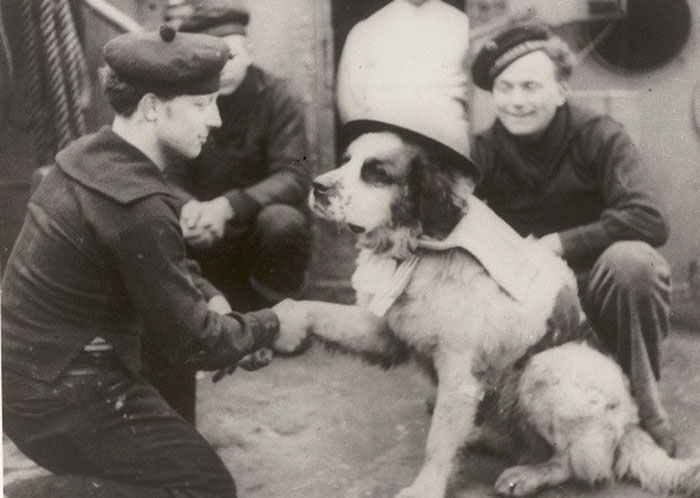
Bamse, a Saint Bernard, was inducted as an official crew member of a Norwegian fighting ship during World War 2. The canine was known for breaking up fights amongst his crew-mates by putting his paws on their shoulders and calming them down.

Bamse, a Saint Bernard, was inducted as an official crew member of a Norwegian fighting ship during World War 2. The canine was known for breaking up fights amongst his crew-mates by putting his paws on their shoulders and calming them down.
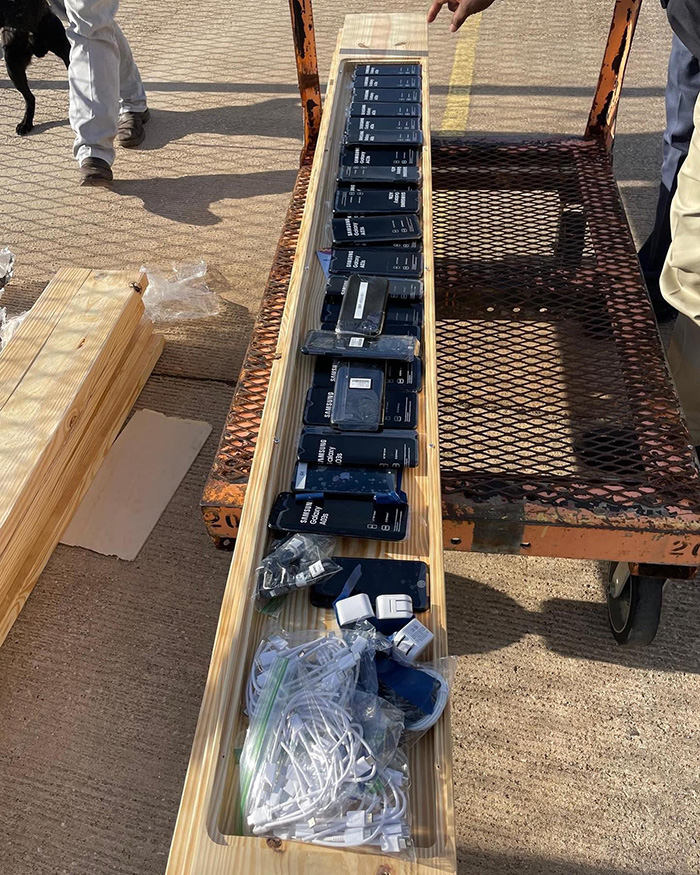
Officers at the Polunsky Unit recently confiscated a piece of hollowed-out wood sent to the facility’s craft shop containing 30 cell phones and cell phone accessories. After further investigation, two civilians, Janette Pizana and John Charles Godoy, were both arrested and charged by Office of the Inspector General investigators with Engaging in Organized Criminal Activity and introducing a Prohibited Item in a Correctional Facility.
(Source)
The iPhone reigns supreme inside correctional facilities — with the newest model commanding up to $6,000. Older versions or other smartphones can sell for as much $3,400; even cracked or damaged devices can still cost up to $2,000.

In the late 1960s, the military demands of the Vietnam War meant that over 200,000 American men had to be drafted every year. In 1969, the Selective Service System instituted a random drawing of birthdates to decide who would be called. As men were needed, the Selective Service System would call up men according to the order that their birthdates were drawn in the lottery. (Thus, those with a low lottery number knew they were very likely to be drafted. Those with a high lottery number could hope that the military’s manpower needs would be filled before their turn came.)
According to the National Archives, there were about 27 million American men eligible for military service between 1964 and 1973. Of that number, 2,215,000 men were drafted into military service. Around 15 million were granted deferments, mostly for education and some for mental or physical problems.
There were more than 300,000 draft evaders in total, of which 209,517 men illegally resisted the draft while some 100,000 deserted. Among them, around 30,000 emigrated to Canada during 1966-72.
In 1977, on his first day in office, President Jimmy Carter controversially offered a full pardon to any draft dodgers who requested one.


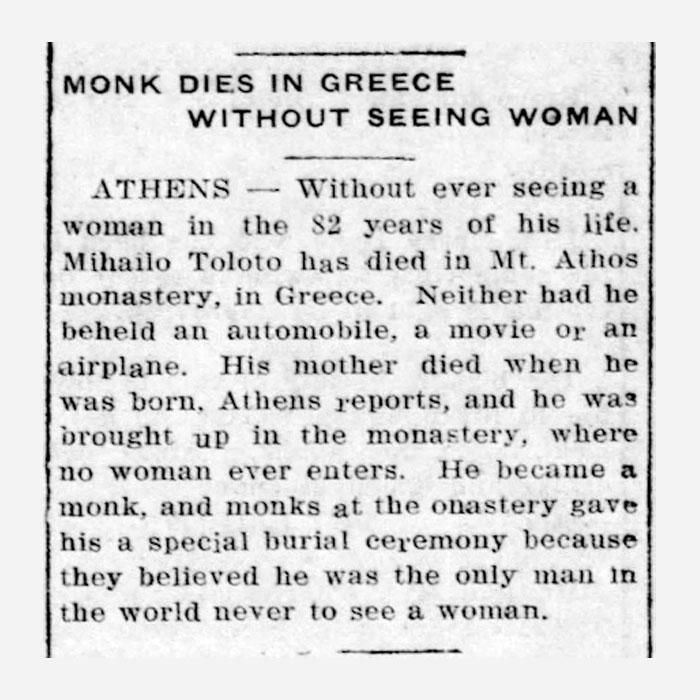
This article was published in an Athens newspaper on October 29th, 1938.
Mihailo Toloto was born in 1856. Shortly after his mother’s death (after giving birth), a few men carried him up to a monastery on Mount Athos (a mountain located on a peninsula in northeastern Greece). He grew up in the monastery and spent his whole life on the peninsula until his death.
In 1046, Byzantine emperor Constantine Monomachos enacted a law, which prohibited women from entering the region so that the monks could live in complete celibacy without temptation. Although Mount Athos is part of the European Union, the monastery has special jurisdiction over the region and has the authority to decide who can and cannot enter.

The trenches of World War I, a grim but iconic aspect of the conflict, epitomized the brutality and stalemate of the Great War. These trenches, dug along the Western Front, extended from the North Sea to the Swiss Frontier with France. Life in these trenches was a harrowing experience, marked by a constant struggle against the elements, the enemy, and the specter of death.

Hans Georg Henke’s story is a poignant illustration of the impact of World War II on the lives of young Germans. At just sixteen years old, Henke, a member of the Hitler Youth, became a symbol of the devastation wrought by the war.
Born into a family soon to be struck by tragedy, Henke’s life took a dramatic turn after the death of his father in 1938 and his mother in 1944. The loss left the family destitute, forcing a young Hans Georg, at just 15, to join the Luftwaffe anti-air squad to support his siblings. His role involved manning a battery of 88mm guns, a significant responsibility for someone so young.
Henke’s life during the war is marked by two contrasting narratives. According to his own account, he was stationed in Stettin and was eventually pushed back towards Rostock as the Soviets advanced. However, American photojournalist John Florea presents a different story. Florea claims to have captured the iconic photographs of a tearful Henke in Hessen, in the village of Hüttenberg-Rechtenbach, north of Frankfurt am Main. These images show a young soldier in despair, overwhelmed by the horrors of war.
The photographs depict Henke crying from combat shock. Florea asserts that Henke’s tears were not due to his world crumbling but rather the immediate shock of combat.
He lived until October 9, 1997, passing away at the age of 69 in Brandenburg, Germany. His story, particularly the powerful images of his capture, has been widely used to


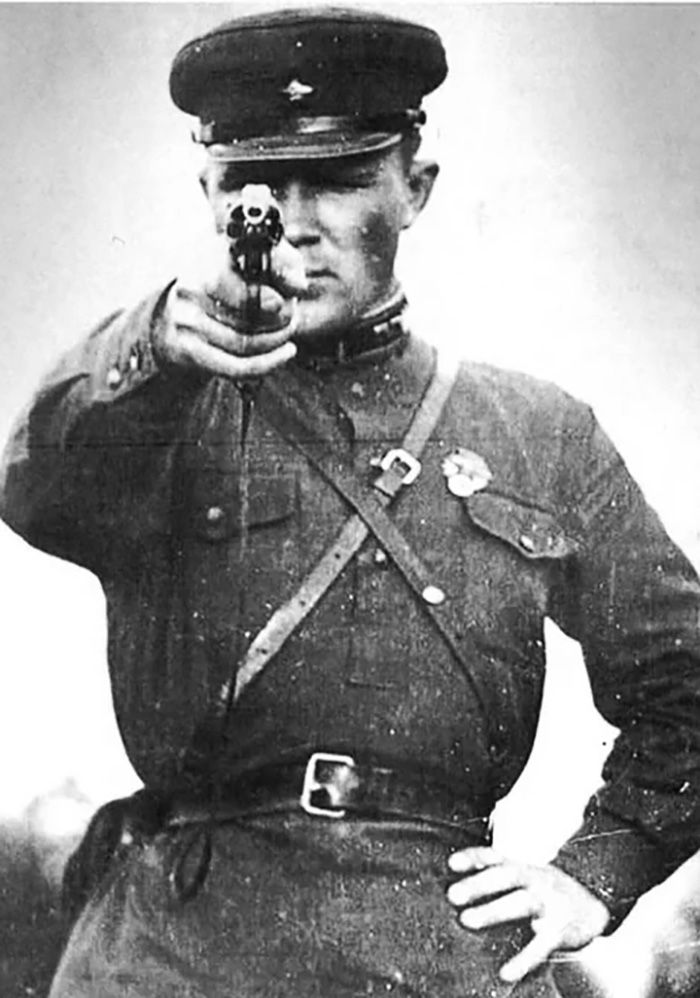
Along with a team of about thirty NKVD men from Moscow, mainly drivers and prison guards, Blokhin arrived at the NKVD prison in Kalinin (Tver) and set himself up in a sound-proofed cellar room that had a sloping floor for drainage. He then put on his special uniform, consisting of a leather cap, long leather apron, and elbow-length gloves.
On a table next to him was a briefcase filled with his own personal Walther PPK pistols, for Blokhin, a true artist at his trade, would use no one else’s tools but his own.
After the prisoner’s identity was verified, he was brought handcuffed into the cellar room where Blokhin awaited in his long apron, like some horrible butcher.
One guard later testified: “The men held [the prisoner’s] arms and [Blokhin] shot him in the base of the skull…that’s all”. Blokhin worked fast and efficiently, killing an average of one man every three minutes during the course of ten-hour nights – the killings were always done at night so that the bodies could be disposed of in darkness.

A local area network (LAN) party is when people get together in a physical space to connect their computers or consoles to the same LAN network and play video games. LAN parties became popular in the 1990s when broadband internet was expensive and uncommon. LAN parties vary in size, from a get-together with a few friends to a major event involving hundreds of strangers.
LAN parties used to be the perfect way to play multiplayer games without relying on split-screen gameplay, often limiting the experience to a maximum of four players.
Common games at LAN parties were those that benefited most from the low-latency and high-reliability environment that a local network provided. First-person shooters (FPS) were particularly popular. Titles like “Counter-Strike,” “Quake,” and “Unreal Tournament” were staples of the LAN party scene.

The pug, with its distinctive round face, curly tail, and playful disposition, is a breed that has captured the hearts of many dog lovers around the world. However, the pug we know today is far from the regal and robust dog it once was. Over a century of intensive breeding has left this beloved breed with grossly distorted features and a litany of health problems, prompting experts to call for urgent action to restore the pug to its original form.
Originally hailing from China, pugs made their way to Europe in the 16th century, quickly becoming the favored pets of European royalty. They were cherished by historical figures like William of Orange, who credited his pug with saving his life, and Empress Josephine, who used her pug, Fortune, to carry secret messages during the French Revolution. Even Queen Victoria, an ardent pug enthusiast, owned as many as 38 pugs during her reign.

The concept of “Four Penny Coffins” is a significant yet somber element in the history of Victorian London, reflecting the plight of the impoverished during that era.
The Victorian era, spanning most of the 19th century, was a time of profound social and economic contrasts. While the Industrial Revolution brought immense wealth and progress to some, it also led to unprecedented levels of poverty and destitution for others. In the overcrowded, disease-ridden slums of London, countless individuals lived on the brink of survival.